 Deutsch
 English
 Türkçe
What Is Over-Harvesting in Hair Transplants? Donor Area Guide
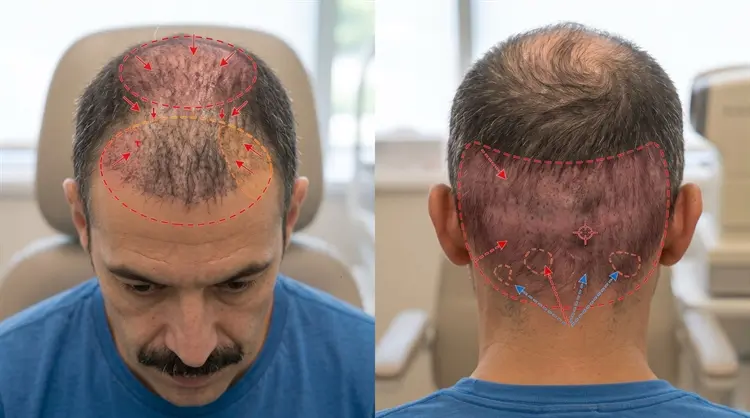
Planning a hair restoration procedure involves focusing heavily on the hairline and the areas where new follicles will be placed. However, the long-term success of any procedure depends just as much on the health and management of the back and sides of the head. When too many hair follicles are extracted from this supply zone during a procedure, a condition known as over-harvesting can occur, leading to visible thinning, patchiness, or permanent aesthetic issues. Understanding what causes this complication, how to recognize the early warning signs, and why precise surgical planning is essential helps individuals make informed decisions and choose clinics that prioritize long-term safety over maximum single-session numbers.
Key Takeaways
- Definition: Over-harvesting happens when too many follicular units are removed from the donor zone, exceeding its natural capacity and causing permanent thinning.
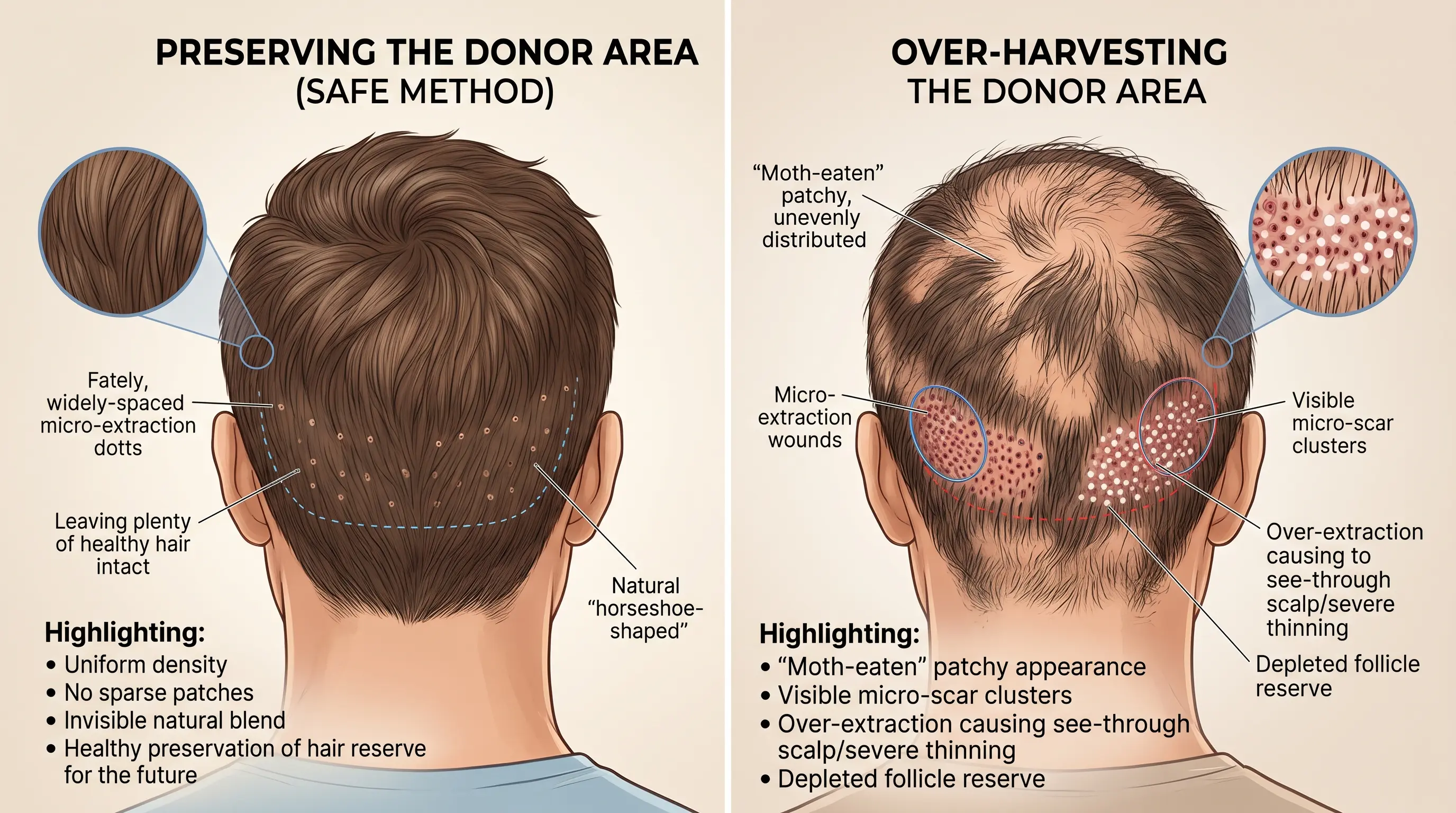
- Consequences: The back and sides of the head may look patchy, moth-eaten, or scarred, making it impossible to wear short hairstyles.
- Prevention: Safe graft extraction relies on respecting the donor-to-recipient ratio, leaving adequate space between extracted follicles, and avoiding aggressive over-extraction.
- Repair: Addressing an over-harvested donor area often requires specialized techniques, scalp micropigmentation, or body hair integration if viable follicles remain.
What is over-harvesting and what does it cover?
Over-harvesting occurs when a surgeon or technician removes an excessive number of hair grafts from the permanent donor zone—typically the occipital and temporal regions at the back and sides of the scalp. Hair follicles in these areas are genetically resistant to the hormone DHT, which causes pattern baldness, making them ideal for transplantation. However, the total supply is finite. When extraction protocols are ignored or excessive grafts are promised in a single session, too many follicles are extracted from close proximity, disrupting the uniform density of the remaining hair. This situation addresses issues related to donor site depletion, visible scarring, moth-eaten hair patterns, and textural mismatch at the back of the head. Individuals with naturally low donor density, fine hair strands, or progressive hair loss who require future procedures are not suitable candidates for aggressive, high-density single-session extractions that risk depleting their reserve supply.
Why is a hair transplant in Turkey and Istanbul so popular?
- Physician experience from case volume: Surgeons and medical teams manage a vast diversity of hair structures, complex corrective cases, and advanced planning scenarios daily, refining their clinical judgment.
- Technology and digital planning: Clinics integrate sophisticated diagnostics like detailed Hair Matrix evaluations to assess donor capacity objectively before a single graft is touched.
- Health-tourism infrastructure: Comprehensive organizational support systems streamline international travel, accommodation, and multilingual patient coordination from arrival to departure.
Online Ön Değerlendirme
Kişiselleştirilmiş saç ekimi planlaması hakkında bilgi alın
Saç çizginiz, tepe bölgeniz ve donör alanınızın net fotoğraflarını göndererek online ön değerlendirme talep edebilirsiniz. Hangi tekniğin (FUE veya DHI) size uygun olduğu ve potansiyel greft sayınız hakkında ön bilgilendirme sağlanır. Nihai planlama, fiziki muayeneniz sonrasında kesinleşir.
Varış öncesi fotoğraf değerlendirmesi · Konaklama ve transfer organizasyonu · İyileşme süreci takibi
How extraction techniques impact donor area preservation
The method used to extract hair follicles plays a fundamental role in whether a donor area heals cleanly or suffers from depletion. Understanding how different technical approaches manage the scalp tissue helps clarify why surgical execution matters just as much as aesthetic design.
1. FUE punch size and depth control
Follicular Unit Extraction relies on specialized micro-punches to isolate individual grafts. When the punch diameter is too wide or motorized rotation is handled without precise depth control, it creates larger micro-wounds that coalesce into noticeable white dot scars, compromising the overall appearance of the donor region. This approach suits individuals with thick, resilient scalps, but carries limitations for patients with fine, lax skin.
2. Selective and homogeneous extraction patterns
Safe extraction requires skipping surrounding follicles systematically rather than harvesting every single hair in a localized patch. A skilled technician distributes the harvest evenly across the entire safe donor zone, maintaining natural density gradients. This technique suits nearly all hair restoration candidates, though its primary limitation is that it requires more procedural time and careful surgical mapping.
3. Respecting safe graft count limits
Every individual possesses a distinct donor capacity based on their scalp surface area and baseline hair density. Exceeding a safe extraction threshold—often pushing past 4,000 to 4,500 grafts in a single session regardless of patient anatomy—virtually guarantees donor thinning. This strategy is suitable only for patients with exceptionally high native density, and its limitation is that pushing absolute maximum numbers often sacrifices long-term donor integrity.
What affects the price and planning of safe graft harvesting?
When considering hair restoration, cost structures are frequently tied to the complexity of the case, the extent of the area requiring coverage, and the medical infrastructure supporting the procedure. Rather than pricing a session solely on an arbitrary high volume of grafts, ethical treatment planning focuses on sustainable resource management.
| Factor | How it changes the price and approach | What to ask the clinic |
|---|---|---|
| Donor Density & Capacity | Determines how many grafts can be safely extracted without risking a depleted appearance. | How do you measure my individual donor capacity before surgery? |
| Session Complexity | Requires advanced surgical skill, meticulous spacing, and specialized instrumentation to protect tissue. | Will the extraction phase be performed directly by experienced medical professionals? |
| Comprehensive Care Package | Includes diagnostic evaluations, integrated complementary treatments, and structured post-operative follow-up. | What medical aftercare and follow-up support are included in the treatment plan? |
Exact treatment costs and graft limits are confirmed only after a comprehensive personal examination and clinical assessment.
Golden rules for choosing the right clinic
- Transparency and accreditation: Verify that surgical procedures take place in fully accredited, sterile hospital environments equipped for comprehensive patient care.
- Who actually performs the treatment: Ensure that critical phases like graft harvesting and channel creation are executed by qualified medical doctors or supervised specialists, not unqualified technicians.
- Doctor experience: Look for documented clinical expertise in managing complex donor zones and preventing over-extraction complications.
- Materials and documentation: Confirm that clinics use certified, high-grade instruments and provide transparent records of your graft distribution.
- Realistic time planning: Reject clinics that promise unrealistic, massive graft yields in excessively short timeframes that compromise surgical precision.
Questions to ask your clinic before you book
- How do you calculate my safe donor harvesting limit during the initial consultation?
- What specific punch size and extraction pattern will be used for my hair type?
- Who will be performing the graft extraction phase of my procedure?
- What safeguards do you have in place to prevent over-harvesting in high-density requests?
- How is the donor area monitored during the immediate healing and recovery phase?
- What options are available if my donor area requires future touch-ups or correction?
- Are integrated therapies included to support both donor healing and graft survival?
- What emergency and medical backup facilities are available at your surgical location?
What to expect: recovery and aftercare for the donor zone
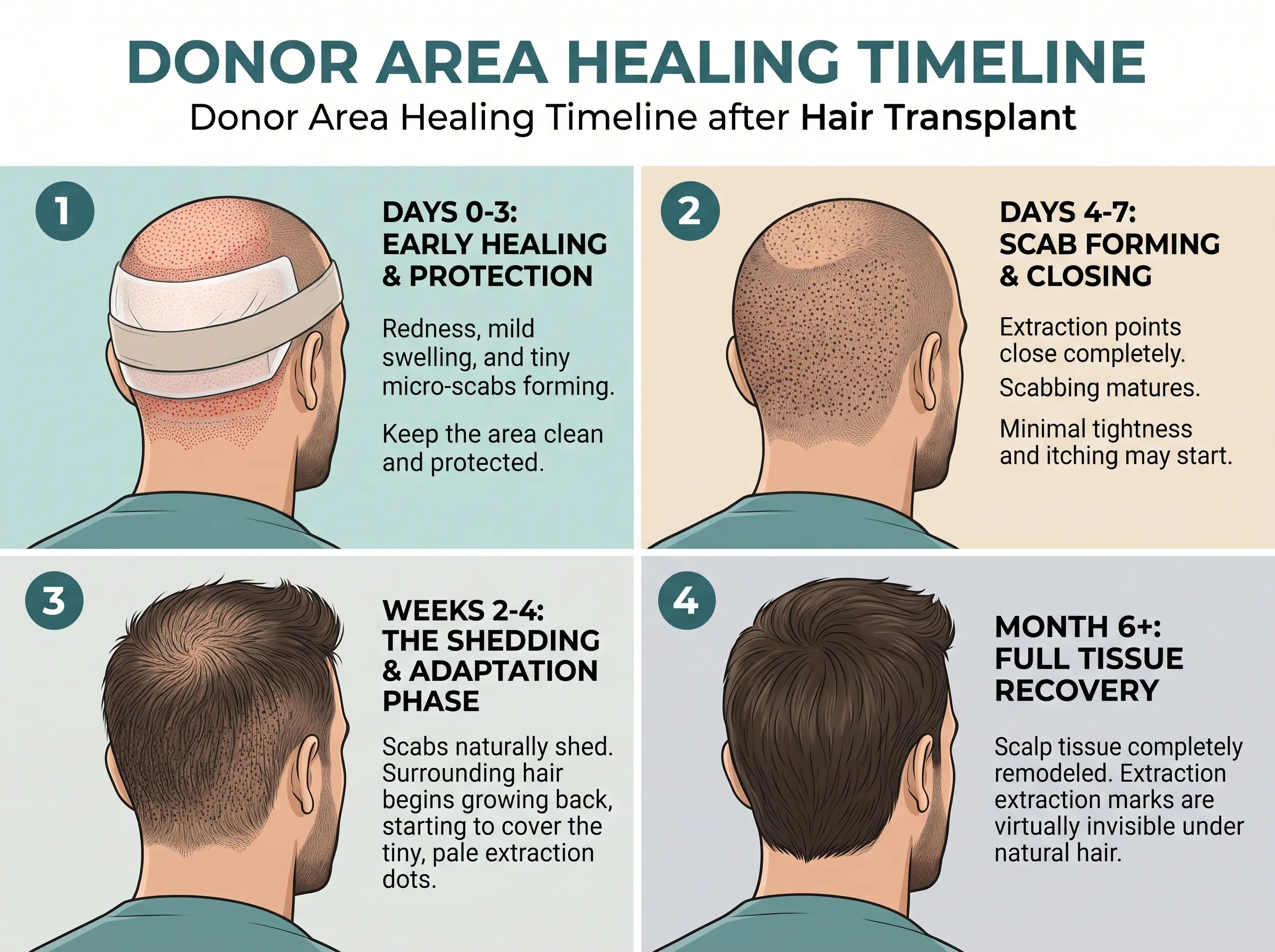
Healing in the donor area follows a predictable timeline that requires patience and adherence to medical guidelines. During the first week, micro-scabs form over the extraction sites, and mild tightness or sensitivity is common. By weeks two through four, initial redness subsides, and the surrounding hair begins to grow over the micro-dots. Over the first three to six months, the scalp tissue fully remodels, and remaining hair follicles settle into their natural growth cycles. Risks associated with improper healing include prolonged inflammation, folliculitis, or visible hypopigmented scarring if extraction was performed too aggressively. Patients should contact their medical team immediately if they experience persistent pain, spreading redness, unusual swelling, or signs of infection in the donor zone.
Post-treatment and the Celyxmed approach
At Celyxmed in Istanbul, hair restoration is approached as a long-term medical commitment rather than a high-volume transaction. Every patient receives a personalized evaluation that begins with a detailed in-clinic Hair Matrix analysis, documenting native density, hair thickness, and growth trajectories to establish objective baseline data. Rather than applying a standard template, medical teams design custom strategies that safeguard the permanent donor reserve, ensuring that the back and sides of the head retain a natural, full appearance. Integrated supportive protocols, including specialized medical care and quality-certified complementary therapies, support optimal healing and tissue recovery at every stage of the process.
Online Ön Değerlendirme
Kişiselleştirilmiş saç ekimi planlaması hakkında bilgi alın
Saç çizginiz, tepe bölgeniz ve donör alanınızın net fotoğraflarını göndererek online ön değerlendirme talep edebilirsiniz. Hangi tekniğin (FUE veya DHI) size uygun olduğu ve potansiyel greft sayınız hakkında ön bilgilendirme sağlanır. Nihai planlama, fiziki muayeneniz sonrasında kesinleşir.
Varış öncesi fotoğraf değerlendirmesi · Konaklama ve transfer organizasyonu · İyileşme süreci takibi
Ready to explore a safe, personalized hair restoration strategy tailored to your unique donor capacity?
Frequently Asked Questions
What causes over-harvesting in a hair transplant?
Over-harvesting typically occurs when too many follicular units are removed from a concentrated area of the donor zone, or when the total graft count exceeds the patient's safe biological capacity. Inexperienced extraction, poor surgical mapping, and attempting unrealistically high densities in a single session are primary contributors.
Can an over-harvested donor area grow back?
No, hair follicles that are completely extracted during FUE or FUT procedures are permanently removed from the donor site and will not regenerate. If surrounding follicles were damaged or miniaturized due to poor extraction spacing, they may experience permanent shock loss or thinning.
What are the visible signs of an over-harvested donor area?
Common signs include patchy thinning, moth-eaten spots, linear or clustered white dot scarring, and an overall see-through appearance at the back and sides of the head. These symptoms often become glaringly obvious if the patient cuts their hair short or buzzes the back.
How can over-harvesting be prevented during surgery?
Prevention relies on careful donor assessment, calculating safe extraction limits based on native hair density, and utilizing homogenous, scattered extraction patterns. Surgeons must leave adequate spacing between harvested sites to preserve the structural integrity and visual continuity of the remaining hair.
How is an over-harvested donor area repaired?
Repairing a depleted donor zone is challenging and depends on available reserves. Options include scalp micropigmentation to camouflage scars, strategic beard or body hair transplantation to supplement coverage, and specialized medical therapies to maximize the health of existing surrounding follicles.
Protecting your donor area is essential for ensuring a natural appearance and preserving options for future hair restoration needs. How does your current hair density and donor condition influence your approach to planning a safe procedure?
Disclaimer: This article is for informational purposes only and should not be construed as professional medical advice, diagnosis, or treatment. Individual results and physiological responses to hair restoration procedures vary. Always consult a qualified medical professional for personalized evaluation and guidance.