
 Deutsch
 English
 Türkçe
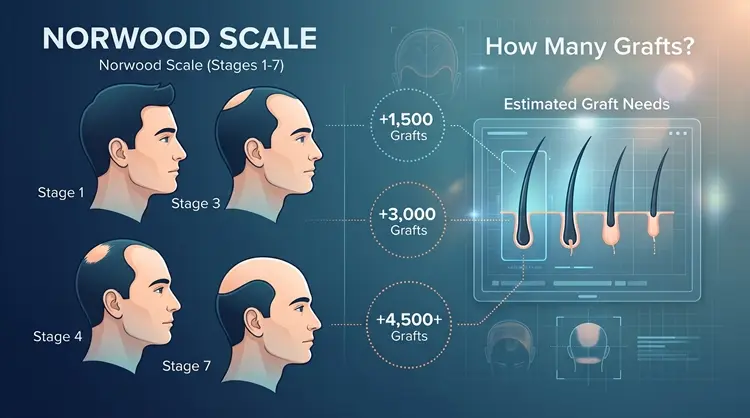
Norwood Scale: Which Stage Are You and How Many Grafts Might You Need?
Watching your hairline change can feel frustrating and unpredictable, but male pattern baldness usually follows a highly specific pattern. Doctors classify this progression using the Norwood scale, a universally recognized measurement system that categorizes hair loss into seven distinct stages. Understanding where you currently sit on this scale is the first step toward finding the right solution, as it helps determine whether you are a suitable candidate for restoration and roughly how much intervention is required. If you are considering a hair transplant, your current stage directly influences the number of grafts needed to achieve natural-looking density. Let us explore the different stages of this scale and what they mean for your restoration options.
Key Takeaways
- The Norwood scale measures male pattern baldness across seven progressive stages.
- Stages 1 and 2 usually do not require surgery, while stages 3 to 6 are typical transplant candidates.
- Graft counts vary widely, typically ranging from 1,500 for minor recession to over 4,500 for advanced loss.
- Final graft requirements depend entirely on your donor area density and hair characteristics, requiring professional evaluation.
What is the Norwood scale and what does it cover?
The Norwood scale (often called the Hamilton-Norwood scale) is the primary classification system that specialists use to measure and categorize male pattern baldness. It helps determine the severity of hair loss and the most appropriate restoration techniques.
- Standardized tracking: It provides a universal language for specialists to discuss your hair loss progression accurately.
- Treatment planning: The scale helps determine if you are ready for a transplant or if non-surgical medical aesthetics are better suited for now.
- Donor area assessment: Higher stages require careful evaluation to ensure enough healthy hair remains for a successful transfer.
Not everyone is a suitable candidate. Individuals in stage 7 with very weak or sparse donor areas at the back of the head may not have enough transferable hair for full coverage.
How many grafts do you need? Stages and estimates
Your current stage heavily influences your estimated graft count. The figures below are broad industry averages; your exact needs will depend on your unique head size and desired density.
1. Stages 1 and 2: Early recession
Stage 1 represents a natural hairline with no visible loss, while stage 2 shows slight recession around the temples. Surgery is usually not recommended at these early stages. Doctors often suggest monitoring the progression or exploring non-surgical treatments to maintain existing density.
2. Stages 3 and 4: Moderate hair loss
Stage 3 is when hair loss becomes clinically significant, typically presenting as a deep "M" or "U" shape at the temples. Stage 4 features more severe recession and a distinct bald spot on the crown, separated by a band of dense hair.
3. Stages 5 to 7: Advanced baldness
In stage 5, the band of hair separating the crown and hairline narrows significantly. By stage 6, this bridge disappears entirely, leaving a large bald area. Stage 7 is the most advanced form, where only a horseshoe-shaped band of hair remains around the sides and back.
| Norwood Stage | Typical Graft Estimate |
|---|---|
| Stages 1 and 2 | Monitoring usually recommended |
| Stage 3 | 1,500 – 2,500 grafts |
| Stage 4 | 2,500 – 3,500 grafts |
| Stage 5 | 3,500 – 4,500 grafts |
| Stages 6 and 7 | 4,500+ grafts (may require multiple sessions) |
Note: Exact graft requirements are confirmed only after a personal examination of your donor area.
To find out exactly how many grafts you need, you can request a free online consultation and photo evaluation with our specialists.
What factors affect your final graft count?
Beyond your stage on the Norwood scale, several physiological factors dictate the final number of grafts required for a natural-looking result.
- Donor area density: A thick, healthy donor area at the back of the head allows for higher extraction numbers without causing noticeable thinning.
- Hair caliber: Thicker, coarser hair strands provide more surface coverage per graft than fine hair, meaning you might need fewer overall grafts to achieve visual density.
- Head size: The physical surface area of your scalp affects how many grafts are needed to fill a specific Norwood stage.
- Future hair loss: Doctors must plan not just for your current stage, but for potential future thinning, ensuring enough donor hair is kept in reserve for later years.
Post-treatment and the Celyxmed approach
At Celyxmed in Ataşehir, Istanbul, our hair transplant team with over 15 years of experience carefully evaluates your Norwood stage before planning your procedure. We utilize advanced digital planning to map out your recipient area, ensuring the extracted grafts are distributed for maximum natural density. Patients benefit from a comprehensive photo evaluation before arrival, allowing our experts to provide a realistic assessment of what can be achieved based on their individual donor capacity.
Contact us today for a free online consultation to determine your Norwood stage and get a personalized graft estimate.
Frequently Asked Questions
Can you reverse a Norwood stage 4 without surgery?
Non-surgical methods can help slow down further hair loss and improve the quality of existing hair, but restoring a fully receded hairline typically requires a surgical hair transplant.
What is the difference between FUE and DHI for different Norwood stages?
FUE is generally used for extracting and implanting large numbers of grafts efficiently in higher stages. DHI is often preferred for adding density without shaving the recipient area, making it popular for earlier stages.
Do I have to wait until stage 4 for a transplant?
No. Many patients choose to restore their hairline at stage 3, provided their hair loss pattern has stabilized and they have sufficient donor hair to support the procedure and future needs.
What happens if I do not have enough donor hair for my stage?
If your Norwood stage is high but your donor area is weak, doctors may focus on framing the face with a natural front hairline rather than covering the entire crown, or they may advise against surgery entirely.
Understanding your hair loss pattern is the most important step in finding the right medical solution. Which stage of the Norwood scale closely matches your current hairline?
The information provided in this article is for educational purposes only and does not substitute for professional medical advice. Individual results and graft requirements may vary.