
 Deutsch
 English
 Türkçe
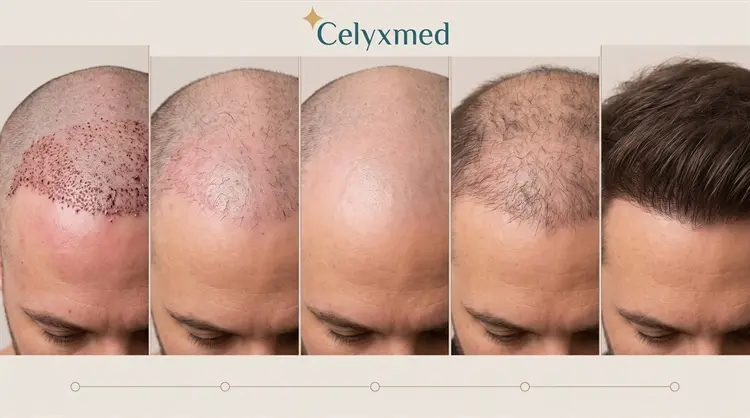
Hair Transplant Recovery Timeline: Week by Week Guide
You have finally made the decision to restore your hair, but one big question remains: what does the downtime actually look like? It is completely natural to feel anxious about the days following your procedure. Will people notice? When can you comfortably go back to work? A successful procedure is just the beginning; the real transformation happens during your hair transplant recovery. Knowing exactly what to expect helps you plan your schedule, protects your investment, and eases the emotional ups and downs of waiting for your new hair to grow. Here is a comprehensive guide to navigating your week by week hair growth journey smoothly.
Key Takeaways
- The initial healing phase typically takes about 7 to 10 days, during which minor swelling subsides and scabs naturally shed.
- A sudden shedding of transplanted hairs usually occurs between weeks two and four—this is a normal resting phase, not a failure of the grafts.
- Noticeable new hair growth typically begins around months four to six, improving in thickness and density over the following year.
- Strict adherence to your prescribed post hair transplant care routine is essential for maximizing graft survival and achieving a natural look.
What is the hair transplant healing process and what does it cover?
The healing process encompasses the biological stages your scalp goes through from the moment the follicles are extracted and implanted until the final hairs fully mature. Because hair follicles are delicate micro-organs, moving them triggers a natural trauma response in the skin, followed by a prolonged regeneration cycle.
A standard recovery process typically covers:
- Incision healing: The closing of the tiny micro-wounds in both the donor (back of the head) and recipient (balding) areas.
- Graft anchoring: The critical first few days where the newly implanted follicles establish a fresh blood supply.
- Follicular cycling: The shedding of the initial hair shafts and the eventual sprouting of permanent new hairs.
Who is not a suitable candidate?
Individuals with unmanaged autoimmune conditions, active scalp infections, or those unwilling to follow strict aftercare protocols for the first few weeks are generally not advised to undergo the procedure.
Why is getting a Turkey hair transplant 2026 so popular?
Patients worldwide frequently choose Turkey as their destination for hair restoration. This continued preference is driven by several key factors:
- Physician experience from high case volume: Surgeons and medical teams in Istanbul handle a vast number of diverse hair types and loss patterns daily, refining their manual dexterity and design skills.
- Technology and advanced planning: Leading clinics utilize modern extraction tools, advanced preservation solutions, and precise digital hairline mapping to enhance graft survival rates.
- Comprehensive health-tourism infrastructure: The process is typically designed around international patients, combining airport transfers, dedicated patient coordinators, and multi-lingual support into a seamless experience.
Reach out to our team for a free online consultation to discuss your hair restoration options.
Most commonly used methods and FUE recovery time
The technique used for your procedure can subtly influence the early days of your recovery. While the long-term growth cycle remains the same, the extraction and implantation tools vary.
1. Sapphire FUE
This method uses ultra-sharp blades made from synthetic sapphire rather than traditional steel to open the micro-channels in the recipient area. The smoother, V-shaped incisions typically cause less tissue trauma. This usually translates to a slightly faster early FUE recovery time, with reduced swelling and quicker scab formation. It is highly suitable for patients needing high-density placement. One limitation is that the procedure still requires shaving the recipient area for optimal precision.
2. DHI (Direct Hair Implantation)
DHI utilizes a specialized tool called a Choi implanter pen, which allows the surgeon to implant the extracted follicle directly into the scalp without creating prior incisions. This technique offers excellent control over the angle and direction of the hair. It is often preferred for patients who want an unshaven procedure or smaller touch-ups. However, DHI is typically more time-consuming, meaning large sessions may require longer hours in the surgical chair.
3. Traditional FUE (Follicular Unit Extraction)
In traditional FUE, follicles are extracted individually using a micro-punch and implanted into pre-made slits using forceps. It is a highly versatile method that works well for a wide variety of hair types and extensive hair loss cases. The limitation is that traditional steel blades may cause slightly more initial redness compared to sapphire tools, though the overall healing timeline remains very similar.
What to expect: Your week by week hair growth timeline
Understanding the physiological changes your scalp will experience is the best way to avoid unnecessary panic.
Days 1 to 7: Immediate healing and scab formation
The first week is about protecting the fragile new grafts. You will likely experience mild swelling on your forehead and around your eyes, which typically peaks around day three. The recipient area will be covered in tiny red dots that will quickly harden into small scabs. The donor area may feel tight and slightly itchy. During this time, you must sleep with your head elevated and avoid any physical exertion that increases your heart rate. Your clinic will guide you through a specific, gentle washing protocol to keep the scalp clean without dislodging the follicles.
Weeks 2 to 4: The shedding phase
By the end of the second week, most of the scabs should have washed away, leaving the scalp looking slightly pink but clean. This is when the dreaded "shock loss after hair transplant" usually begins. The visible hair shafts attached to the implanted follicles will start to fall out. This is a completely normal biological reaction to the surgical transition; the root of the follicle remains securely anchored beneath the skin.
Months 2 to 4: The resting phase
Often referred to as the "ugly duckling" phase, this period requires the most patience. The transplanted hairs have shed, and the follicles are resting beneath the surface. You may look exactly as you did before the surgery, and the scalp may still have a faint pinkish hue. Do not worry—this quiet period is essential for the follicles to build the strength needed to push out new, permanent hairs.
Months 5 to 9: New growth emerges
This is when the excitement begins. Fine, baby-like hairs will begin to sprout from the scalp. Initially, these hairs may appear thin, lighter in color, or even slightly wavy or wiry. As the months progress, the hair will gradually thicken, darken, and align with your natural hair texture. By month nine, you should be able to see a significant improvement in coverage and density.
Months 10 to 12: Final maturation
Between the tenth and twelfth month, the hair shafts fully mature, reaching their maximum thickness and caliber. The density will look natural, and you can comfortably cut, style, and wash your hair exactly as you please. For crown areas, full maturation can sometimes take up to eighteen months due to lower blood circulation in that specific region.
Golden rules for choosing the right clinic
Your recovery experience is directly linked to the surgical standards of the facility you choose.
- Prioritize accreditation and transparency: Always look for clinics that operate in certified hospital environments rather than commission-based intermediary agencies with opaque medical practices.
- Verify doctor and team experience: Hair restoration requires intense teamwork; ensure the medical staff has years of dedicated experience specifically in follicular extraction and implantation.
- Request real, unfiltered before-and-after cases: Look closely at the hairlines in different lighting conditions, paying attention to the natural direction and density of the growth.
- Ask about materials and documentation: Professional clinics use single-use, high-grade medical tools and will provide you with a clear document stating your exact graft count post-surgery.
- Expect realistic time planning: A reputable provider will give you an honest assessment of what can safely be achieved in one session without over-harvesting your donor area.
Questions to ask your clinic before you book
To ensure you are fully prepared for the journey, keep this checklist handy during your initial consultations:
- Who exactly will be performing the extraction and the channel opening?
- Is the facility equipped to handle medical emergencies during the procedure?
- What specific post hair transplant care products are provided or required?
- How long should I plan to stay in the country for the initial recovery checks?
- How will the clinic monitor my progress once I return to my home country?
- What happens if the graft survival rate is significantly lower than expected?
Post-treatment and the Celyxmed approach
At Celyxmed, based in Ataşehir, Istanbul, our hair transplant team brings over 15 years of experience to every patient's restoration journey. All aesthetic surgeries are performed in JCI-accredited partner hospitals to maintain rigorous safety standards. We support your healing process with comprehensive aftercare instructions and advanced options like exosome therapy to encourage optimal follicle health. Long after you return home, we stay connected through regular photo evaluations to monitor your progress every step of the way. Certified by ISO 9001, ISO 13485, and USHAŞ, our focus is on transparent, supportive care.
Contact us today for a free photo evaluation and let our team map out your personalized restoration plan.