 Deutsch
 English
 Türkçe
Dental Implant Brands in Turkey: How to Choose the Right Quality for Your Smile
Traveling abroad to restore missing teeth is an effective option, but comparing different clinic quotes can leave you overwhelmed by unfamiliar manufacturer names. Researching dental implant brands in Turkey requires looking past marketing claims to understand what actually sits beneath your gumline for decades to come. Your choice influences osseointegration speed, biological compatibility, long-term stability, and whether replacement parts will remain accessible worldwide if you ever need maintenance in your home country. Gaining clarity on material grades, manufacturer track records, and clinical suitability helps you make an informed decision for your oral health. This comprehensive guide breaks down the primary implant categories in Turkish clinics, key quality benchmarks, and essential questions to ask your dental surgeon before confirming your treatment plan.
Key Takeaways
- Implant longevity depends primarily on titanium purity, surface topography, and surgical precision rather than brand marketing alone.
- Turkish dental clinics generally provide two main tiers: premium global brands with decades of documented research and certified value brands offering reliable biocompatibility.
- Opting for an internationally recognized system ensures replacement abutments and prosthetic screws remain accessible worldwide should you require dental care at home.
- A thorough 3D volumetric bone scan and your general health profile dictate which implant diameter, length, and surface design suit your anatomy.
What are dental implant brands and why does manufacturer quality matter?
Dental implant brands refer to specialized medical device manufacturers that engineer prosthetic titanium or zirconia fixtures placed into the jawbone to anchor artificial crowns, bridges, or dentures. Quality matters because manufacturing precision, surface texture, and clinical trial history directly determine how quickly your bone fuses with the implant and how securely the restoration endures chewing pressure over decades.
- Single and multiple tooth replacement: Independent titanium posts replace lost tooth roots without requiring neighboring healthy teeth to be trimmed down for bridges.
- Full-arch oral rehabilitation: Strategic placement of four to six implants supports entire arches of fixed teeth in protocols such as All-on-4 or All-on-6.
- Preservation of jawbone structure: Biocompatible fixtures transmit natural chewing forces into the alveolar bone, preventing the bone resorption that naturally occurs following tooth loss.
- Facial aesthetic support: Restoring dental arch height and structural tooth volume preserves natural facial dimensions, preventing sunken lip and cheek contours.
Patients with uncontrolled systemic conditions such as unmanaged diabetes, active periodontal infection, or those currently undergoing radiation therapy to the head and neck are typically not suitable candidates until their health stabilizes.
Why are dental implant treatments in Turkey so popular among international patients?
International patients frequently choose Turkey for restorative dentistry because the country combines clinical expertise with accessible treatment planning.
- Physician experience from case volume: Dental surgeons in major medical hubs like Istanbul manage a wide variety of complex restorative cases annually, giving them practical proficiency across diverse bone densities and full-arch configurations.
- Technology and digital planning: Leading clinics utilize cone-beam computed tomography (CBCT) scanners, digital impression wands, and computer-guided surgical templates to position fixtures with sub-millimeter precision.
- Health-tourism infrastructure: Structured medical coordination, multilingual patient support, and organized appointment schedules allow international visitors to complete multi-stage dental procedures comfortably within planned travel windows.
To receive a personalized treatment plan and discover which implant system matches your bone structure, contact our clinic for a free online consultation.
Primary dental implant categories offered in Turkish clinics
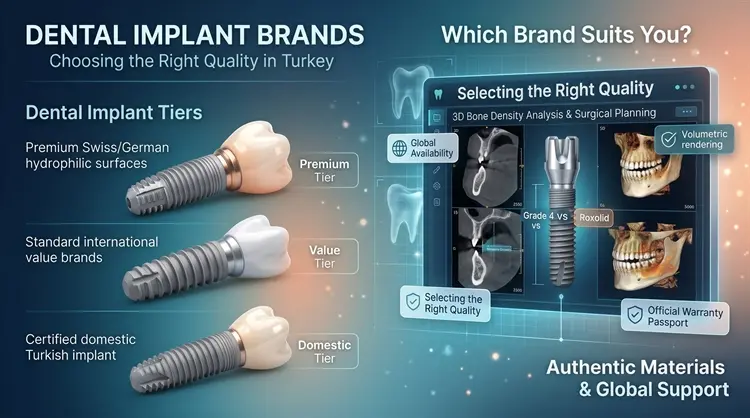
Understanding how implant manufacturers differ helps you weigh long-term durability against your personal budget. Clinics in Turkey generally offer three primary tiers alongside specialized ceramic options.
1. Premium Swiss and German implant systems
Global industry pioneers such as Straumann represent the top tier of implant technology, supported by decades of peer-reviewed clinical trials and patented hydrophilic surface treatments. These surfaces attract blood proteins and osteoblasts rapidly, accelerating the osseointegration window to as little as three to four weeks in favorable cases. They suit patients with compromised bone density, controlled diabetes, history of smoking, or those requiring immediate-load protocols. The primary limitation is their higher production cost, which translates into a higher overall treatment fee compared to standard alternatives.
2. Standard international value brands
Value-tier manufacturers based in countries such as Israel, the United States, and South Korea, including systems like Medigma, Osstem, and Hiossen, utilize medical-grade pure titanium with standard sandblasted, acid-etched (SLA) surfaces. These fixtures provide proven biocompatibility and dependable bone integration for straightforward single-tooth or multi-unit restorations in patients with adequate bone volume. Their limitation lies in bone healing timelines, which generally require the conventional eight to twelve weeks, and a narrower selection of specialized components for rare anatomical irregularities.
3. Certified domestic Turkish implant lines
Turkey possesses an established medical manufacturing sector producing domestic implant systems certified under European CE directives and ISO 13485 standards. These systems offer solid mechanical strength and surface purity for patients seeking functional tooth replacement with lower material overheads. They suit standard clinical indications where bone volume is abundant. The main limitation is lower international brand recognition, meaning a general dentist in the UK or US may not carry the proprietary restorative screwdrivers or matching abutments if maintenance is required years later.
4. Ceramic and zirconia metal-free implants
Zirconia implants are non-metallic, ceramic fixtures designed for individuals seeking holistic alternatives or those presenting thin gingival biotypes where metallic shadows could show through anterior gum tissue. They resist plaque accumulation and offer high aesthetic compatibility in the smile zone. However, their single-piece or specialized two-piece designs provide less surgical flexibility, cannot always be angled after osteotomy placement, and carry higher material costs.
What affects the cost of dental implant brands in Turkey?
The total investment for implant dentistry varies depending on manufacturing pedigree, material composition, diagnostic imaging requirements, and necessary bone enhancement procedures. Premium fixtures demand greater research and development investments, which reflect in wholesale pricing, whereas standard systems focus on cost-efficient manufacturing of established designs.
| Factor | How It Changes the Price | What to Ask the Clinic |
|---|---|---|
| Brand Tier and Origin | Swiss and German systems carry higher manufacturer licensing and patent fees than standard value brands. | Which specific manufacturer and tier is quoted in my treatment plan? |
| Titanium Grade vs. Zirconia | Grade 4 commercially pure titanium and Roxolid alloys differ in raw cost from non-metal zirconia fixtures. | Is the implant body manufactured from cold-worked titanium or ceramic? |
| Surface Chemistry Technology | Chemically active hydrophilic surfaces add manufacturing steps that increase fixture expense. | Does this implant feature a standard SLA surface or a fast-healing active surface? |
| Prosthetic Component Authenticity | Using original manufacturer abutments and screws costs more than generic third-party prosthetic copies. | Are the abutments and connecting screws original to the implant brand? |
| Preparatory Bone Augmentation | Sinus lifts, bone grafting granules, and barrier membranes add surgical time and material overhead. | Does my 3D scan show sufficient native bone, or will bone grafting be required? |
Note: Exact treatment costs and component requirements are confirmed only after a personal clinical examination and 3D volumetric radiograph.
Golden rules for choosing the right dental clinic
Selecting an implant brand is only half the equation; surgical execution and diagnostic planning determine whether your implant achieves lasting stability.
- Transparency and accreditation: Choose facilities certified by the Turkish Ministry of Health for international medical tourism, holding recognized quality standards such as ISO 9001 and ISO 13485.
- Who actually performs the treatment: Verify whether your surgery is executed by a qualified oral and maxillofacial surgeon or an experienced implantologist, rather than a general practitioner performing occasional placements.
- Doctor experience and case exposure: Evaluate the clinical background of the dental team, specifically their familiarity with complex full-mouth restorations and anatomical bone variations.
- Materials and authentic documentation: Ensure the clinic provides an official manufacturer passport containing the original lot numbers, batch codes, and serial barcodes for every placed fixture.
- Realistic time planning: Reputable clinics never rush osseointegration; they respect biological healing periods rather than forcing permanent crowns onto unintegrated fixtures prematurely.
Questions to ask your clinic before you book
Before confirming your dental travel arrangements, review this checklist with your chosen healthcare provider:
- What specific brand and model of implant do you recommend for my bone type, and why?
- Will I receive an official manufacturer implant passport with original barcodes at the end of treatment?
- Are the abutments and prosthetic attachments genuine components produced by the same manufacturer?
- What qualifications and surgical experience does the doctor placing my implants hold?
- How many days do I need to remain in Istanbul for the initial surgical phase?
- What temporary tooth solution will I wear while osseointegration takes place?
- What is your protocol if an implant fails to integrate during the initial healing period?
What to expect: recovery and aftercare timeline
Dental implant integration is a biological journey that progresses in distinct phases, requiring consistent oral hygiene and patience as living bone cells attach to the titanium surface.
1. Days 1 to 3: Initial recovery and blood clot formation
Mild swelling, minor bruising, and slight oozing around the surgical site are normal physiological responses. Apply cold compresses externally to your cheek in twenty-minute intervals during the first twenty-four hours. Consume soft, room-temperature foods, take all prescribed anti-inflammatory medications and antibiotics as directed, and avoid strenuous exercise. Do not rinse vigorously, spit forcefully, or drink through a straw, as negative pressure can dislodge the protective blood clot.
2. Weeks 1 to 2: Soft tissue closure and suture removal
Gingival tissues heal rapidly around the healing abutment or cover screw. Continue chewing on the opposite side of your mouth and maintain careful oral hygiene by brushing non-treated areas normally and using prescribed chlorhexidine rinses gently. If non-resorbable sutures were placed, your dental surgeon removes them between days seven and ten. Discomfort should be minimal to non-existent by this stage.
3. Months 2 to 6: Osseointegration and definitive restoration
Beneath the gumline, osteoblasts bridge the microscopic pores of the implant surface in the process of osseointegration. Lower jaw placements typically integrate within two to three months, while upper jaw fixtures often require four to six months due to lower bone density. Avoid smoking throughout this period, as nicotine constricts microvascular blood flow and increases the risk of early failure. Once integration is verified via radiograph, final digital impressions are taken, and your permanent zirconium or porcelain crown is secured.
4. When to contact a doctor
Reach out to your clinic immediately if you experience persistent throbbing pain that worsens after day three, numbness in your lip, chin, or tongue lasting past initial anesthesia, continuous bleeding, or noticeable mobility in the implant post.
Post-treatment and the Celyxmed approach
Located in Ataşehir, Istanbul, Celyxmed combines over 10,000 treatments across its medical departments with a dedicated team of more than 50 healthcare professionals. Our dental aesthetics department prioritizes digital CBCT imaging and clinical precision, working exclusively with certified, internationally traceable implant systems. Patients receive full pre-travel photo and radiographic assessments, organized airport and hotel transfers, and comprehensive post-procedure documentation including authentic implant warranty passports.
Contact us today to schedule your free online consultation and receive a personalized evaluation of your dental implant options.
Frequently Asked Questions
How do I know if my dental implant is genuine?
Every genuine medical implant comes in a sterile, tamper-evident container with peel-off adhesive labels detailing the brand, model, diameter, length, and unique lot number. Your clinic must affix these labels directly into an official implant passport provided to you upon treatment completion.
Is a premium implant brand always necessary?
Not always. While premium brands like Straumann offer advantages in compromised bone, active systemic health conditions, or accelerated loading timelines, certified value brands provide high success rates in patients with healthy bone volume and standard oral anatomy.
Can my dentist back home service an implant placed in Turkey?
Yes, provided you choose an internationally recognized brand with global distribution. If your clinic uses systems supported worldwide, your local dentist can easily obtain matching screwdrivers, replacement abutments, or new prosthetic screws whenever routine maintenance is needed.
What is the typical success rate of dental implants?
Reputable titanium implant systems exhibit clinical success rates typically between 95% and 98% over long-term observation periods. Success depends heavily on surgical planning, bone density, meticulous patient oral hygiene, and non-smoking habits throughout the healing phase.
What happens if I have insufficient jawbone for an implant?
Patients with diminished bone volume can still receive implants following preparatory procedures such as bone grafting or sinus floor elevations. Alternatively, shorter or narrower specialized fixtures may be planned to utilize existing bone without risking nerve impingement.
Choosing the right dental implant system creates the foundation for decades of functional chewing and an authentic smile. Which factor matters most to you: the global brand heritage of the implant or the clinical experience of your surgeon?
The information provided in this article is for educational purposes only and does not substitute for professional medical advice. Individual treatment plans and results may vary.