 Deutsch
 English
 Türkçe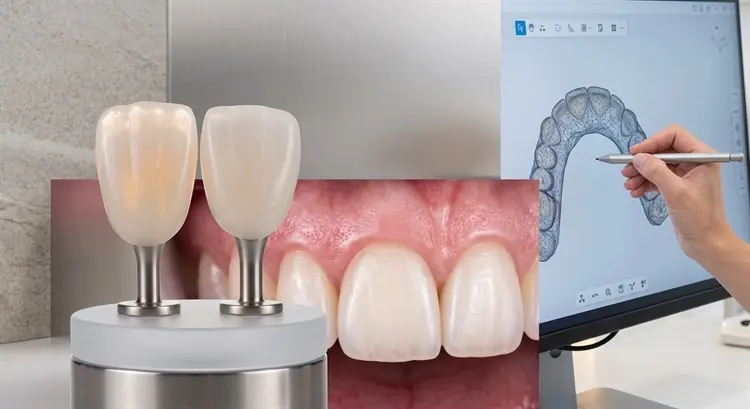
Zirconium and E-Max Crowns: Biocompatibility and Material Science Comparison
When you decide to renew your smile, one of the first concerns that usually comes to mind is "Will it look artificial?" or "Will it cause bruising on my gums?". The gray reflection created at the gum line by metal-supported porcelains, which were frequently used in past years, has caused aesthetic concerns for many patients. In today's modern dentistry, two revolutionary materials that combine aesthetics and health stand out: zirconium dental veneers and E-Max crowns. These two options not only mimic the natural tooth perfectly but also show excellent biological harmony with the human body. Here is a comprehensive guide on biocompatible dental veneer options and the differences between zirconium and E-max:
Key Takeaways
- Zirconium dental veneers are metal-free white alloys generally preferred for back teeth and long bridges due to their outstanding chewing resistance.
- E-Max crowns are glass ceramics with light transmittance closest to natural tooth enamel and rank first, especially in anterior region aesthetics (smile design).
- Both materials are 100% biocompatible; they do not cause metal allergies, gum recession, or gray discoloration at the gum line.
- The choice between the two materials should be determined by the dentist based on the tooth's position in the mouth, the patient's chewing force, and aesthetic expectations.
Zirconium or E-Max? Key Differences and Comparison Table
The answer to the question of whether Zirconium or E-Max can be summarized by zirconium being superior in areas requiring structural durability and resistance, while E-Max is superior in anterior regions requiring maximum transparency and aesthetics. While zirconium offers an opaque and hard structure, E-Max has a more delicate structure that perfectly copies the light refraction properties of natural tooth enamel.
The main differences between the two materials in terms of material science and clinical performance are as follows:
| Feature | Zirconium Dental Veneer (Zirconium Dioxide) | E-Max Crown (Lithium Disilicate) |
|---|---|---|
| Light Transmittance (Translucency) | Medium - Good (Higher in modern monolithic ones) | Excellent (Closest to natural enamel) |
| Durability (Fracture Resistance) | Very High (Usually 900-1200 MPa) | High (Usually 360-500 MPa) |
| Ideal Area of Use | Back molars, bridges covering long gaps | Anterior incisors, single veneers, short bridges |
| Material Structure | Zirconium element-based white crystal form | Lithium disilicate-based glass ceramic |
| Need for Tooth Abrasion | Usually requires more space | Usually less (can be worked thinner) |
What is a Zirconium Dental Veneer and When is it Preferred?
Zirconium dental veneer is a highly durable, white-colored infrastructure material obtained from "zirconium dioxide", the oxidized form of the zirconium element found in nature. By replacing the gray metals used under traditional porcelain veneers, it offers both aesthetics and mechanical resistance simultaneously.
The most ideal situations for zirconium veneers are:
- In the restoration of back molars exposed to high chewing forces.
- In long-span bridge applications where there are multiple missing teeth.
- To mask the dark color underneath with its opaque structure in teeth with severe discoloration (antibiotic stains or darkening caused by root canal treatment) on the underlying main tooth.
- To minimize the risk of fracture in patients with a history of severe teeth grinding (bruxism).
Who is it not suitable for? Although zirconium is aesthetic, it does not have the same light transmittance as glass ceramics. Therefore, it may not be the first choice in cases where a single front tooth is to be veneered and an exact optical match with the highly transparent, natural tooth next to it is sought.
What is an E-Max Crown and When is it Preferred?
E-Max (E.max) is a type of crown containing glass ceramics, whose main material is lithium disilicate, developed with the "Esthetic Maximum" philosophy. It does not contain a hard infrastructure like metal or zirconium; the entire material is produced from ceramic blocks that can refract and reflect light. In this way, it perfectly mimics the thinness and vitality of natural teeth.
The most ideal situations for E-Max crowns are:
- In aesthetic restorations of incisors and canines located in the anterior group within the scope of smile design.
- In closing the gaps between teeth (diastema) or correcting slight crowding.
- In cases where a natural, vibrant whiteness is desired without dulling thanks to its light transmittance.
Who is it not suitable for? Lithium disilicate material does not have the same stretching and fracture resistance as zirconium. Therefore, it is generally not recommended to be used in long bridges in the back molar region or in patients with untreated severe teeth grinding (bruxism) disorders.
Biocompatibility: How Do Your Gums React to These Materials?
Both zirconium and E-Max crowns are highly biocompatible dental materials; meaning they are not perceived as a foreign object by human tissue and do not trigger the immune system. They are completely resistant to the moist and acidic environment in the mouth, do not corrode, and, unlike traditional metals, do not carry the risk of allergic reactions.
One of the biggest advantages material science offers to dentistry is tissue-friendly surfaces. Corrosion (oxidation) can occur over time in metal-supported porcelains, which causes a purple/gray ring to appear at the gum border. Zirconium and lithium disilicate (E-Max), on the other hand, contain zero metal. Thanks to their smooth surface structures, bacterial plaque retention is even lower compared to natural tooth enamel. This ensures that the gums around the veneers remain healthy, pink, and tight. In addition, since their thermal insulation is very good, they do not cause hot-cold sensitivity.
Factors Affecting Dental Aesthetics and Veneer Prices in Turkey
Although dental aesthetics applications in Turkey are performed using world-class materials in terms of material science, they are much more accessible compared to Europe and America thanks to local operating costs and exchange rate advantages. The main factors affecting the costs are; the brand of the material to be used (e.g. global manufacturers like Ivoclar Vivadent), the digital equipment of the laboratory, the number of teeth to be treated, and the additional treatments required by the case (root canal treatment, gum shaping, etc.).
Average Cost Comparison (Zirconium and E-Max Crowns)
| Country | Zirconium Veneer (Single Tooth) | E-Max Crown (Single Tooth) |
|---|---|---|
| Turkey | Approximately 60-70% more advantageous | Approximately 60-70% more advantageous |
| United Kingdom (UK) | High | Very High |
| USA | Very High | Highest |
*Exact treatment planning and costs are confirmed after your personal jaw structure and teeth are evaluated via panoramic X-ray.
Golden Rules for Choosing the Right Clinic
When planning an aesthetic and permanent dental treatment, it is necessary to focus not only on the material but also on the experience of the team that will apply the procedure and the infrastructure of the clinic:
- Transparent Communication and Authorization: Instead of intermediary brokerage institutions, choose clinics that directly provide healthcare services and have authorization certificates approved by the T.R. Ministry of Health (like USHAŞ).
- Unfiltered Case Examples: Examine real patient before/after photos of the clinic's previous zirconium and E-Max procedures that have not been manipulated with studio lighting.
- International Quality Standards: Make sure the clinic has quality certificates for material, process, and patient safety such as ISO 9001 and ISO 13485.
- Material Transparency: Request the brand and certificate information of the zirconium blocks or E-Max ceramics to be used in the treatment from the clinic in advance.
- Realistic Time Planning: A good laboratory phase and gum adaptation require time. Stay away from unrealistic plans that promise the treatment will be finished in a few hours.
Post-Procedure Period and the Celyxmed Approach
As Celyxmed, we have successfully completed more than 10,000 treatments at our center in Ataşehir, Istanbul, providing services with over 50 professionals who are experts in their fields. In zirconium and E-Max crown treatments, we follow fully personalized smile design procedures in accordance with our ISO 9001 and ISO 13485 quality standards. For the comfort of our patients, we offer integrated planning that includes accommodation and transfer processes, in addition to the photo and X-ray evaluations we provide before arrival in the country. Our goal is for you to achieve long-lasting results both aesthetically and functionally with biocompatible materials.
You can contact us for an online preliminary evaluation to find out which material is best suited for your mouth structure and to plan your treatment.
Is your indecision about which material is more suitable for you based on your aesthetic expectations (light transmittance) or your pursuit of durability?
*This article has been prepared for general information purposes only, it is not a substitute for medical advice, and individual treatment results may vary from person to person.