 Deutsch
 English
 Türkçe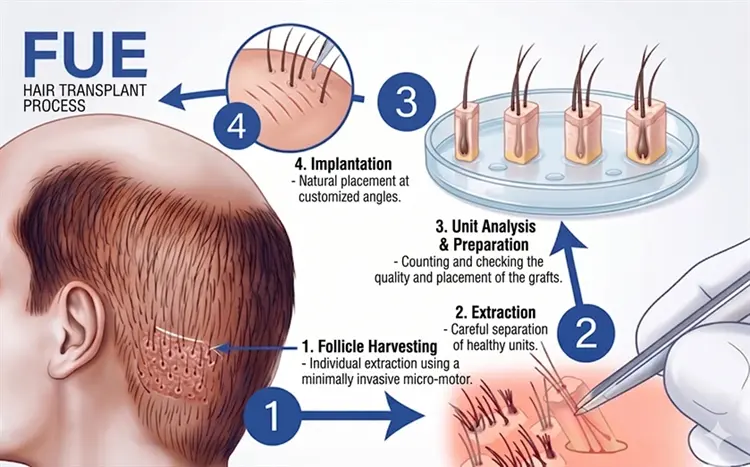
What is FUE Hair Transplantation? How is it Done?
Hair loss is not just a physical change; it is also a psychological process that has profound effects on an individual's self-confidence. FUE hair transplantation, one of the most advanced solutions offered by modern aesthetic surgery, reverses this process and allows individuals to be at peace with their reflection. When many patients come to us and ask "is trust?" (is it a matter of trust?), our answer is always "yes." Because hair transplantation is not just a medical procedure, but an artistic restoration. At Celyxmed, our goal is to ensure every patient leaves the clinic with the motto "be your best." In this journey, the right technique, correct planning, and an unwavering trust relationship are the keys to success.
FUE Hair Transplant Procedure: Historical Process and Modern Approach
The FUE hair transplant procedure is based on the principle of extracting hair follicles individually from the donor area (usually the nape and sides) and transplanting them to the areas in need. Unlike the old "strip" (FUT) method, this technique leaves no stitch marks and the healing process is much faster. The FUE hair transplant application offers the surgeon great flexibility in preserving the natural growth direction and angle of the hair.
The success of the technique is directly related to the precision of the tools used. This is where the concept of micro FUE hair transplant comes into play. Instead of the standard tips used in traditional methods, the use of much smaller diameter (0.6mm - 0.8mm) tips ensures that hair follicles are extracted without damage. This precision guarantees that there will be no thinning or scarring in the donor area post-operation. Hair transplantation offers a natural look only when performed with this level of meticulousness.
Psychological Effects of the FUE Technique and Patient Satisfaction
When a patient regains their hair, it changes not just their appearance, but their social life as well. The smile factor is the clearest indicator of a successful operation. The natural happiness a patient feels when they see the thinning areas filled in while looking in the mirror is the true success of the procedure for us. An elite service approach ensures the patient sees this process not just as a surgery, but as a "self-renewal" experience.
Micro FUE Hair Application: The Intersection of Engineering and Art
Micro FUE hair application elevates hair transplantation to the level of a craft. The micro-motors or manual punches used in this method are designed to cause minimum damage to the tissue surrounding the hair follicle. During this process, the experience of the surgeon is critical for maintaining the viability of the grafts (hair follicles).
One of the most curious topics for those considering hair transplantation is FUE hair transplant prices. However, when performing a price analysis, factors such as whether the technology used is "micro," the expertise of the team performing the operation, and the sterilization standards of the clinic should be considered. FUE hair transplant is not a cost, but a lifelong investment. A low-quality application can lead to irreversible tissue damage; therefore, it is vital to focus on "quality and trust" parameters rather than price when making a choice.
Technical Stages of the Operation and Donor Management
Donor area management during the FUE hair transplant application is one of the most critical stages of the operation. Hair follicles are a limited resource. Using this resource correctly means planning not just for today's transplant, but also for future needs.
Homogeneous Extraction
Follicles must be extracted from the donor area in such a pattern that no gaps or patches are formed after the procedure.
Graft Preservation
The extracted follicles must be kept in special solutions at the appropriate temperature until the transplantation stage.
Natural Planning
The hairline should be determined with "micro" details appropriate to the patient's age and facial features.
Expert Note: "A true elite hair transplant is one where it cannot be noticed from the outside that a transplant has been performed. Thanks to micro FUE hair transplant, we achieve natural hair density while reducing tissue damage to zero. We calculate the angle of every single hair strand with millimetric precision so our patients can reach their goal to 'be your best'."
Sapphire FUE Hair Transplant: The Healing Power of Precious Stones
As technology advanced, the tools used in the FUE hair transplant method also evolved. The pinnacle of this evolution is undoubtedly the sapphire FUE hair transplant technique. While steel blades are used to open channels in the classic FUE method, tips produced from real sapphire ore are used in this method. So, what does a stone have to do with hair transplantation? The answer lies in its tissue-friendly nature and smooth structure.
Sapphire FUE tips are much sharper, more durable, and smoother than steel blades. This ensures that the tissue under the skin is exposed to much less trauma during the channel opening process. Less trauma means less edema, less crusting, and a much faster healing process. For our patients, this means returning to social life quickly and experiencing maximum post-operative comfort. This is exactly where we build trust: protecting the patient's health and comfort with the latest technology. Every micro-channel opened in your scalp is a precise step on the path to reaching your 'be your best' goal.
Advantages of Sapphire Tips and Density
Sapphire FUE hair transplant allows the surgeon to open more frequent channels. The V-shaped structure of sapphire blades allows follicles to be placed closer to each other, providing a much denser hair appearance. Especially in aesthetically critical areas like the front hairline, the angle of the hair follicles can be adjusted with millimetric precision using sapphire tips. This ensures that results are so natural they "cannot be recognized as a transplant." in an elite clinic, these details are not a coincidence but a result of the sapphire technology used.
FUE or DHI? Making the Right Decision
The biggest debate in the hair transplant world is usually this: FUE or DHI? Both methods actually stem from the FUE foundation, but their application styles differ. In the FUE vs DHI comparison, what determines which method is more suitable for you is your hair loss type and expectations.
The FUE hair transplant application is unrivaled in cases where wide areas need to be covered (for example, Norwood 5-6 level loss). Very high graft numbers can be reached in a single session. DHI (Direct Hair Implantation) is performed using "Choi Implanter" pens and is generally ideal for patients who want an unshaven transplant or only want to thicken sparse areas. However, it should not be forgotten that a transplant performed with sapphire FUE rivals DHI in terms of healing speed and density. During the decision phase, our team analyzes your hair structure to provide the most accurate guidance; because for us, what matters most is that happy smile on your face after the operation.
Sapphire FUE and DHI Comparison Table
| Feature | Sapphire FUE | DHI (Pen Technique) |
|---|---|---|
| Application Area | Ideal for wide balding areas | Suitable for regional thickening |
| Maximum Grafts | 5000-6000+ (High) | 3000-3500 (Medium) |
| Channel Opening | Pre-opened with sapphire tips | Opened during implantation with pen |
| Healing Process | Very Fast (Tissue-friendly sapphire) | Fast |
| Shaving Requirement | Usually required | Can be performed unshaven |
FUE Hair Transplant Prices and Investment Value
There is a lot of misleading information on the internet regarding FUE hair transplant prices. However, the price of an elite service is measured not just by the procedure time, but by the quality of the equipment used (e.g., original sapphire FUE tips). Low-cost operations are usually performed by compromising on sterilization, team quality, or the technology used. When doing a true price-performance analysis, one should also consider the material and moral loss that would occur if the operation fails. Hair transplantation is done once and carried for a lifetime. That's why the answer to the "is trust?" question lies in the guarantees and references provided by the clinic. At Celyxmed, with a transparent pricing policy, we provide a world-class FUE hair transplant service, ensuring you get the return on your investment with the most natural results.
Expert Note: "Our patients often get stuck on the FUE vs DHI question. However, what really matters is which instrument the surgeon can perform the best 'art' with. Sapphire FUE hair transplant is our favorite because it gives us the freedom to provide the most tissue-respectful and dense results. The moment you feel your best—your 'be your best' point—comes through this correct technique choice."
The Day of the Operation: How Does the FUE Hair Transplant Application Begin?
The process that starts the moment a patient steps into our clinic is actually the first step of a friendship and trust relationship that will last for months. The FUE hair transplant application is not just a technical procedure, but also a meticulous preparation phase. The process, which starts in the morning, begins with the final hair analysis and the millimetric drawing of the transplant areas. This drawing stage is the most critical point for the future natural appearance of the hair. If the hairline is too low or too high, it ruins the naturalness of the result. Our goal is to create the most aesthetic design that will allow the patient to reach their "be your best" potential.
The anesthesia stage is the part many patients fear most. However, in modern FUE hair transplant procedure protocols, the sensation of pain is minimized thanks to needle-free anesthesia techniques. After local anesthesia is applied, the patient can comfortably watch television or listen to music. An elite hair transplant experience should make the patient feel like they are in a care center, not an operating room.
Collecting Grafts from the Donor Area: The Micro FUE Hair Transplant Difference
The first technical stage of the operation is the collection of grafts. Here, micro FUE hair transplant principles come into play. Hair follicles are collected homogeneously from the nape area. If the extraction is done unevenly, a "patchy" appearance may occur in the nape area after healing. Celyxmed experts analyze the root structure of each hair strand and select the healthiest grafts.
Graft Quality
It is essential that the collected roots are taken without being fragmented, preserving their integrity.
Tissue-Friendly Approach
Thanks to micro-tips, the holes opened on the skin are so small that they close completely within a few days.
Speed and Precision
Team coordination must be at the highest level to reduce the time grafts spend outside the body.
Channel Opening and Placement: Sapphire FUE and the Artistic Touch
After the graft collection process is completed, a short break is taken, followed by the most important phase: channel opening. If we have decided on sapphire FUE hair transplant with our patient, real sapphire-tipped pens are used at this stage. Sapphire tips allow channels to be opened much narrower and smoother. This smoothness helps the transplanted hair follicle hold onto the tissue more firmly.
The most important factor to consider when opening channels is the concept of "angle and direction." Hair does not grow perpendicularly from the scalp; every region has its own unique slope. If these angles are not correctly set during the micro FUE hair application, the hair grows with an artificial appearance often described as "grass man." Every follicle placed with the correct angle ensures that the patient will have a sincere smile when looking in the mirror in the future.
FUE or DHI? The Moment of Decision During Application
Many patients continue to ask FUE vs DHI until they lie down on the operation table. Actually, this decision should have been finalized during the pre-operative consultation. However, during the operation, the surgeon may make small optimizing changes in technical details based on the efficiency of the donor area and the thickness of the hair strands. The choice of FUE vs DHI also affects the duration of the operation according to the size of the patient's hairless area. More area can be covered in a shorter time with the FUE method, while DHI requires longer and more patient craftsmanship.
The Cost of Trust: What Determines FUE Hair Transplant Prices?
The quality of the operation directly shapes the cost of the operation. Very low figures seen in the market regarding FUE hair transplant prices should bring the question "is trust?" to mind. A quality anesthesia kit, single-use sapphire FUE blades, and an expert surgical staff require a certain cost. Small savings made at this point can lead to larger expenses in the future, such as revision surgeries, and most importantly, loss of morale. Remember, this procedure is an intervention on your skin and directly on your health.
CEO Note: "The day of the operation is the moment the patient feels safe. We don't just transplant hair; we rebuild a person's self-confidence. With micro FUE hair application, we aim for the most elite results without compromising on perfectionism. Because we know that our best advertisement is that happy smile our patients share with their new hair."
The First 15 Days After Surgery: The Critical Healing Phase
The first two weeks after the FUE hair transplant procedure is completed are vital for the transplanted follicles to take root in their new homes. During this process, the patient's sense of trust in our clinic is reinforced by their strict adherence to the instructions we provide. The first 48 hours is the period when the transplanted follicles are most sensitive. At this stage, it is necessary to avoid any impact to the scalp and not to touch the transplanted area. Remember, those small grafts are currently only in a physical placement; they need time to establish biological bonds with the tissue.
The first wash after FUE hair transplant application is usually performed 24 to 48 hours after the operation by our specialists in a clinical setting. This wash is performed with special solutions to prevent crusting and disinfect the area. An elite clinic experience requires providing the patient with all the necessary care sets and training in this process. The patient's first smile moment when looking in the mirror is usually this first wash when they see the donor area healing quickly and the transplant area cleaned.
Crusting and Shock Loss: The "Is Trust?" Test
Around the 10th day of the healing process, the small crusts formed on the scalp fall off completely. After this stage, the most surprising situation awaiting patients is the "Shock Loss" phase. A large portion of the transplanted hair strands fall out between the 2nd and 8th weeks. Many patients may panic at this point and ask "is trust?" (was something done wrong?). However, this is a completely natural reaction of the body. The hair follicles remain inside; only the strands fall out and go into a resting phase to grow back stronger. Keeping your morale high during this process and focusing on your 'be your best' goal is the key to success.
Healing Differences After Sapphire FUE and Micro FUE
The technology used directly affects the healing speed. In our patients who have had sapphire FUE hair transplant, tissue trauma is much lower because the channel opening process is done with sapphire tips. This brings the following advantages:
Less Edema
Swelling around the eyes and forehead is much rarer in the sapphire method.
Rapid Wound Closure
Millimetric channels opened with micro FUE hair application heal 30% faster than standard metal blades.
Natural Appearance
Since the crusting process is lighter, the patient can return to work life much earlier.
FUE or DHI? Comparison in the Healing Process
In the FUE vs DHI comparison, the DHI method can sometimes seem more advantageous in terms of the healing process because channel opening and placement are done simultaneously, which can reduce the amount of bleeding. However, micro FUE hair transplant techniques have advanced so much that when performed by an expert staff, the difference is almost imperceptible. What matters is that your scalp can receive the oxygen it needs and the equipment used is of elite sterilization standards.
Long-Term Care and Factors Supporting Success
Hair transplantation is a process, not a single result. While the hair growth rate in the first 6 months is at the level of 50-60%, it can take 12 to 18 months to see the full result. During this period, supportive treatments offered within FUE hair transplant prices (Mesotherapy, PRP, or special vitamin sets) increase your hair quality.
Nutrition
Eating a diet rich in protein and zinc nourishes the hair follicles.
Avoiding Harmful Habits
Smoking and alcohol can reduce tissue oxygenation, lowering the survival rate of hair follicles.
Regular Check-ups
At Celyxmed, we do not leave our patients alone in this long marathon; we monitor their progress with our digital tracking systems.
CEO Recommendation: "Patience is the most important component of hair transplantation. Trust yourself during that 'shock loss' phase after the operation. The micro FUE hair transplant technology we use guarantees that those roots are there and will flourish when spring comes. A real smile is possible with the permanent fullness that comes at the end of patience."
Long-Term Results: Is FUE Hair Transplant Permanent?
The most critical question in many patients' minds is: "Will the transplanted hair fall out?" At this point, the concept of trust merges with medical facts. The follicles used during FUE hair transplant are taken from the "safe zone" at the back of the head. Hair in this area is genetically resistant to the DHT (Dihydrotestosterone) hormone, which causes hair loss. Therefore, hair transplanted with the FUE hair transplant procedure maintains this resistance in the new area. So yes, the results are for a lifetime.
However, the be your best philosophy requires protecting not just the transplanted hair, but also the existing hair. Even if the transplanted hair does not fall out, the person's own natural hair may continue to thin. This situation can lead to what we call the "island appearance," which looks artificial. Therefore, elite planning should cover not just today, but the patient's hair loss projection for 10-20 years later. Hair design should be done by leaving room for natural thinning compatible with the aging process.
Aging Process and Adaptation of the Hairline
As time passes, head structure and skin elasticity change. The natural hairline created with micro FUE hair application should harmonize with facial features even as age advances. A very aggressive and very low hairline may look artificial in one's 50s. At Celyxmed, we take into account the patient's future smile expression and their charisma in their mature years when creating the design.
FUE vs DHI: What if a Second Operation is Needed?
In some cases, if hair loss covers a very wide area, a second session may be required. Here, the question of FUE vs DHI arises again. If the donor area was used efficiently with micro FUE hair transplant in the first operation, sufficient capacity remains for the second session.
FUE Advantage
Uses the donor area more homogeneously to cover wide gaps.
DHI Advantage
Is more successful at densifying between existing transplanted hairs.
If you ask "is trust?" in the FUE vs DHI debate; trust lies with the surgeon who tells the patient not which method will look better on them, but which method will best protect their donor capacity. It should not be forgotten that if the donor area is exhausted, there is no turning back. Therefore, in an elite center, the principle of "optimum graft and maximum protection" is adopted, not "maximum grafts."
Sectoral Trends: Artificial Intelligence and Robotic FUE
How will the FUE hair transplant application be shaped in the future? Even now, AI-supported hair analysis systems can calculate which follicle is healthier and at what angle it should be taken. However, the sensitivity of the human hand and that organic contact of the sapphire tips with the tissue during sapphire FUE hair transplant are still beyond robotic systems. The future belongs to surgeons who use technology as a tool but never abandon artistic vision.
FUE Hair Transplant Prices and Technological Investment
As technology advances, there is also pressure on FUE hair transplant prices. Although robotic surgeries and AI analysis increase costs, they lower the risk of unsuccessful operations by minimizing the margin of error. From the perspective of an investor and CEO; the most expensive operation is the one that fails and needs to be redone. Quality hair restoration is the most economical solution in the long run.
Expert Note: "Hair transplantation is not just about filling gaps; it is about filling those gaps with a story compatible with your character and age. Micro FUE hair transplant offers us the most precise pens to write this story. For a successful result, the trust you should have in your clinic comes from your belief in their aesthetic vision as much as their investment in technology."