 Deutsch
 English
 Türkçe
Dental Implant Costs in Istanbul & Treatment Guide: 2026 European Comparison
Missing teeth do not just affect your physical appearance. They disrupt your chewing balance, cause neighboring teeth to drift, and lead to permanent bone loss (resorption) in your jaw over time. Today, dentists consider dental implants the most natural, durable, and biologically compatible solution to replace missing teeth. With state-of-the-art medical technology, high surgical success rates, and international clinic standards, Istanbul has become one of the most preferred dental hubs across Europe and neighboring regions.
Patients considering this journey often prioritize understanding costs: "How much do dental implants cost in Istanbul?" and "Which implant procedure is right for me?" The overall budget for a dental implant surgery depends on several factors: the patient's jawbone density, the selected surgical method, the quality of the ceramic crown, and the chosen implant brand. In this comprehensive guide, we explain how each procedure works—from single implants to full-mouth restorations—while reviewing 2026 average benchmark prices and the significant cost savings between Europe and Turkey.
Key Takeaways
- All figures provided are estimated reference costs for 2026. Final pricing is established only after reviewing a 3D dental tomography scan and completing a surgical oral evaluation.
- Getting dental implants in Istanbul offers 60% to 70% cost savings compared to European countries, while maintaining identical medical and material quality.
- Surgical planning is tailored to the patient’s anatomy and budget, utilizing recognized global brands such as premium Straumann dental implants or balanced, cost-effective options like Medigma implants.
- Single tooth gaps are restored using individual titanium posts without altering adjacent teeth, while severe tooth loss is addressed through All-on-4 or All-on-6 protocols.
Dental Implant Treatments and What They Do
Implant surgery is not a one-size-fits-all procedure. The number of gaps, bone density, and biting force dictate the specific clinical approach required.
1. Single Tooth Implant: The Permanent Solution Protecting Healthy Teeth
In traditional dental bridge treatments, replacing a single missing tooth required shaving and trimming down two healthy neighboring teeth. A single tooth implant eliminates this compromise. A medical-grade titanium screw is placed directly into the empty jawbone socket, recreating the tooth from root to crown. Because it transmits functional chewing forces into the bone, it effectively halts bone resorption in that area.
2. All-on-4 Dental Implants: Fixed Teeth for Bone Resorption Cases
When patients have lost all teeth or require complete extractions, the posterior jawbone is often insufficient due to sinus enlargement or bone deterioration. The All-on-4 technique places four implants per jaw: two straight in the anterior region and two angled in the posterior region to bypass sinus and nerve canals. What is its primary benefit? It drastically minimizes the need for extensive bone grafting or sinus lifting, allowing patients to receive fixed, non-removable temporary teeth on the same day or shortly after surgery.
3. All-on-6 Dental Implants: Maximum Chewing Strength and Durability
If bone volume and density are favorable, six implants are placed into the arch instead of four. What is its primary benefit? It distributes biting forces more evenly across the jaw. This setup provides superior stability, enhanced durability, and a completely natural chewing feel when eating firmer foods. It is often recommended for younger patients or individuals with strong masticatory muscles.
4. Full Mouth Dental Implants
This is a comprehensive restoration designed for patients with total edentulism in both the upper and lower jaws. Full mouth dental implants permanently eliminate the frustrations of removable dentures, such as slipping, mouth sores, and speech impediments. They restore the natural vertical height of the face, fill out hollowed cheeks and lips, and provide a renewed, youthful facial contour.
5. What Are Bone Grafts and Sinus Lifts Used For?
Following tooth loss, the unoccupied jawbone steadily loses volume over time, while upper sinus cavities tend to expand downward. An implant requires at least 10–12 mm of vertical bone height and sufficient width to remain stable. Bone grafting and sinus lift surgery create the necessary foundation by rebuilding new bone mass, ensuring your implants achieve permanent biological integration (osseointegration).
Europe vs. Turkey: 2026 Dental Implant Price Comparison
International patients choose Istanbul primarily for its balance of high-end clinical quality and affordable treatment rates. The dental implant bodies used in Turkish clinics are certified, serial-numbered products identical to those in leading European hospitals. The price discrepancy does not reflect material quality; it results from lower operational clinic overhead, favorable exchange rates, and lower laboratory costs.
| Treatment Type | European Average Price (2026) | Istanbul Average Price (2026) | Difference (Savings) |
|---|---|---|---|
| Single Tooth Implant (Premium Brand) | €2,000 – €3,500 | €800 – €1,200 | 60% - 65% |
| Single Tooth Implant (Mid-Tier Brand) | €1,200 – €1,800 | €400 – €600 | 65% - 70% |
| All-on-4 System (Single Arch) | €10,000 – €15,000 | €3,000 – €8,000 | 55% - 70% |
| All-on-6 System (Single Arch) | €14,000 – €20,000 | €4,000 – €10,000 | 60% - 70% |
| Sinus Lift (Per Side) | €800 – €1,500 | €300 – €600 | 60% - 65% |
| Bone Grafting (1 cc Bone Powder Application) | €400 – €700 | €150 – €300 | 55% - 60% |
Note: The pricing details above represent estimated industry averages. Additional procedures such as extractions, temporary prostheses, or premium zirconia crowns will shape the customized plan.
Implant Brand Options: Straumann and Medigma Segments
Long-term surgical success depends on how effectively the titanium post integrates with surrounding bone cells. Surface roughness, hydrophilic properties, and thread design all influence this biological fusion. Dentists frequently compare systems across different segments:
Holding decades of documented research and leading clinical trial success rates worldwide, Swiss-manufactured Straumann dental implants define premium industry benchmarks. They feature proprietary surface engineering that accelerates osseointegration, making them particularly valuable for patients with bone deficiencies, controlled systemic conditions like diabetes, or cases requiring immediate aesthetic loading in the front teeth.
For patients seeking medical reliability and precision engineering within an accessible price bracket, internationally certified options like Medigma implants represent a trusted alternative. With biocompatible titanium alloys and stable primary retention geometry, they perform reliably in both single restorations and complex full-arch All-on-4 or All-on-6 bridges. The choice of implant brand is determined by your clinical bone quality, medical recommendations, and personal budget goals.
Other Factors Influencing Dental Implant Costs
Focusing solely on the price of the titanium screw can be misleading. Additional components contributing to your final investment include:
- Crown Material: Whether the visible prosthetic tooth is made of standard porcelain-fused-to-metal or highly translucent monolithic zirconia directly affects the final quote. Modern cosmetic dentistry primarily utilizes zirconia.
- Surgical Guide (Computer-Guided Surgery): Fabricated via 3D computer tomography, custom surgical stents guide the exact angle and depth of implant insertion, adding a modest digital planning fee while maximizing precision.
- Surgeon Experience: Having the procedure conducted by an oral and maxillofacial surgeon in an accredited, sterile surgical setting safeguards against complications and protects long-term stability.
Transparent and Reliable Pricing with Celyxmed
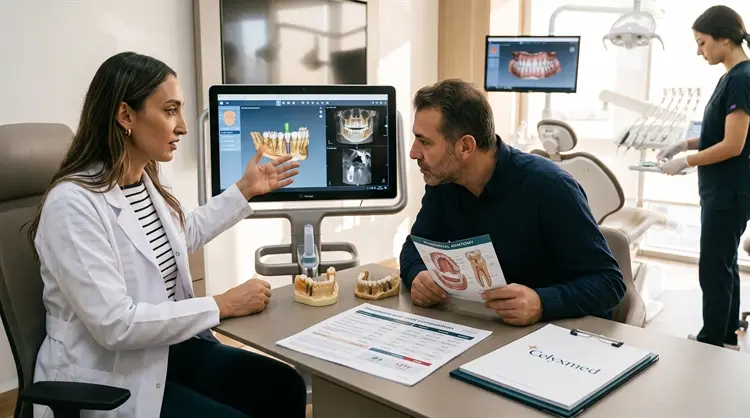
At Celyxmed in Ataşehir, Istanbul, our patients never experience hidden costs or unexpected surgical fees. Our dental specialists evaluate your oral anatomy using comprehensive panoramic X-rays and 3D dental tomography. After assessing bone height, nerve distances, and smile dynamics, we provide written, transparent treatment options tailored to your oral health and budget. All dental implants used in our clinic are original, barcoded products holding complete CE and FDA certifications.
To view your customized treatment costs, calculate your savings compared to European rates, and receive a free preliminary treatment plan, please complete our contact form today.
Frequently Asked Questions
Is there severe pain during or after dental implant surgery?
There is no severe pain during or after dental implant surgery. The procedure is performed under local anesthesia, so you will feel no discomfort while the doctor works. Conscious sedation is also available for anxious patients. Any mild tenderness following the procedure is easily managed with standard pain medications prescribed by your surgeon.
What is the main difference between All-on-4 and All-on-6?
The primary difference between All-on-4 and All-on-6 is the number of implants anchored into the jaw: four versus six. All-on-4 is suitable for patients with localized bone resorption in the posterior jaw. All-on-6 uses six implants to distribute chewing loads across a wider surface area, offering enhanced balance and strength for patients with healthy, dense bone.
Why are dental implant prices in Turkey lower than in Europe?
Dental implant prices in Turkey are lower than in Europe because operating overhead and clinical labor expenses are significantly lower. Favorable currency exchange rates further reduce costs, allowing patients to receive identical branded medical products at much more affordable rates. Surgical equipment and implant materials (such as Straumann) match the highest European hospital standards.
How long does a dental implant last?
A high-quality dental implant can last a lifetime when correctly planned, surgically placed, and maintained with regular brushing, flossing, and routine dental check-ups.
Are implants placed immediately, or how many months do you have to wait?
Implants are not permanently crowned right away; they require a brief healing period to fuse with the bone. This typically takes 2 to 2.5 months in the lower jaw and 3 to 4 months in the upper jaw. If bone grafting or sinus lifting was needed, healing can take up to 6 months. Temporary aesthetic prosthetics are provided so you are never left without teeth.
Restoring a healthy smile and complete chewing function is one of the most rewarding investments you can make for your overall well-being. Would you prefer the world-renowned performance of Straumann or the balanced cost-efficiency of Medigma for your personalized treatment plan?
All price ranges provided in this article reflect 2026 industry averages for general informational purposes. Accurate and customized treatment fees are determined following a clinical and radiological evaluation by your dentist.