 Deutsch
 English
 Türkçe
The Role of Genetic and Epigenetic Factors in Hair Loss: Are Only Our Genes to Blame?
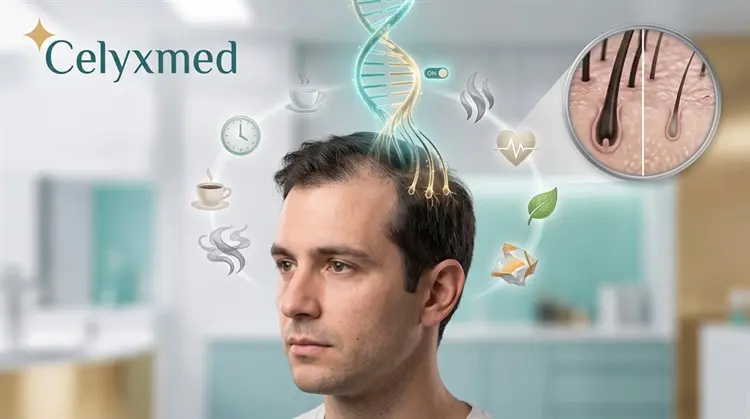
Noticing your hairline receding a little more every time you look in the mirror or counting the hair strands that fall out after a shower is a stressful experience for many people. If you have a family history of baldness, you might tend to accept this situation as an inevitable genetic inheritance. However, modern science shows that the destiny of genetic hair loss is not limited solely to the codes written in our DNA. Environmental and lifestyle factors that determine how and when our genes are "read" can accelerate or slow down the process.
So, is it possible to manage this family inheritance? How do environmental factors affect our hair follicles at the cellular level? Here is a comprehensive guide to androgenetic alopecia, epigenetic mechanisms, and protecting your hair health:
Key Takeaways
- Two-way effect: If genetic background is a "weapon" in hair loss, epigenetic factors (stress, nutrition, sleep) are the mechanism that "pulls the trigger" of that weapon.
- The role of DHT: The main biological cause of male pattern hair loss is the genetic hypersensitivity of hair follicles to the hormone DHT (Dihydrotestosterone), a derivative of testosterone.
- Not destiny, but a manageable process: Although genetic predisposition cannot be completely erased, the miniaturization (shrinking and disappearing) of hair follicles can be slowed down or stopped with the right medical interventions and lifestyle changes.
What is Genetic Hair Loss (Androgenetic Alopecia) and What Does It Entail?
Genetic hair loss, medically known as androgenetic alopecia, is a condition where hair follicles gradually shrink and lose their function due to the effect of androgen hormones (especially DHT) in individuals with a genetic predisposition. While it usually appears in men as a receding hairline starting from the temples and progressing towards the crown, it mostly manifests in women as general thinning and widening at the crown.
This condition basically involves the following processes:
- The gradual shortening of the hair growth cycle (anagen phase).
- Hair strands becoming thinner, shorter, and unpigmented (colorless) in each cycle (miniaturization).
- Hair follicles at the nape and behind the ears remaining resistant to this hormone, while the follicles in the crown and frontal areas weaken.
Who is not a suitable candidate for cellular treatments? People whose hair follicles have completely died, causing the skin tissue in that area to become smooth, resembling a scar (scarring), and who have reached the stage of complete baldness, are not suitable candidates for follicle-stimulating medical treatments; at this stage, the only permanent solution is surgical restoration.
What Role Do the DHT Hormone and Epigenetics Play on Hair?
The DHT hormone and epigenetic mechanisms are two inseparable parts that form the biological basis of hair loss. While your genetic code determines how sensitive your hair follicles are to DHT, epigenetic factors control how intensely these genes will be activated.
- The DHT (Dihydrotestosterone) Effect: Testosterone in the body is converted to DHT by the 5-alpha reductase enzyme. Genetically susceptible hair follicles on the scalp perceive this hormone as a threat. When DHT binds to the follicle, it disrupts the nourishment of the root and shortens the hair's life cycle.
- Epigenetic Factors: Even if your DNA sequence doesn't change, the way your genes work is influenced by your environment. Chronic stress, inadequate sleep, smoking, inflammatory dietary habits, and environmental toxins can cause the genes that trigger hair loss to be "turned on".
- Early Onset: If previous generations in your family experienced hair loss in their 40s, while you are experiencing severe shedding in your 20s, the main reason is usually aggravated epigenetic factors and the chronic cellular stress brought by modern life.
You can contact us for an online preliminary evaluation to understand your hair loss type and learn about repair options tailored for you.
Most Commonly Used Methods / Solutions Against Hair Loss
Balancing genetic and epigenetic effects requires a multifaceted medical approach. The treatment plan is determined according to the vitality of the follicles.
1. Medical and Cellular Support Treatments
Applied in periods when the hair follicles are not yet completely dead but only thinning. PRP (Platelet-Rich Plasma), hair mesotherapy, and exosome therapy, which has become prominent in recent years, are in this group.
- Who it is suitable for: Individuals in the early stages of hair loss who want to improve hair strand quality and slow down the rate of shedding.
- Limitations: They cannot create new hair follicles in areas where complete baldness has occurred and turned into smooth skin tissue; they only strengthen existing, weakened roots.
2. Medication and Topical Lotion Treatments
Includes FDA-approved active ingredients (finasteride, minoxidil, etc.) aimed at blocking the destructive effect of the DHT hormone on the follicle or increasing blood circulation in the scalp.
- Who it is suitable for: Patients diagnosed with androgenetic alopecia who have the discipline for long-term use under a doctor's supervision.
- Limitations: Their effects are limited to the duration the medication is used; when discontinued, the hair loss cycle returns to its previous course within months.
3. FUE and DHI Hair Transplant
It is the transplantation of resistant roots from the nape area, which are genetically coded not to fall out, to replace hair completely lost due to the effect of epigenetic factors or DHT.
- Who it is suitable for: People experiencing advanced hair loss that will not respond to medical treatments and who have sufficient donor capacity.
- Limitations: It is a surgical procedure, and the root reserve in the donor area is not infinite; the existing capacity must be planned carefully.
Golden Rules for Choosing a Reliable Clinic
Choosing the right team for the medical interventions you will undergo to protect or regain your hair health is at least as important as the treatment to be applied.
- Holistic approach: Choose clinics that do not merely market a surgical procedure (hair transplant) to you, but also analyze the genetic and epigenetic dimensions of hair loss and offer preventive medical treatments.
- Expert medical staff: Ensure that the cellular treatments or surgical steps to be applied are managed by experienced medical teams who master anatomy.
- Transparency and realism: Proceed with honest institutions that clearly state that no medical treatment can stop "genetic hair loss 100% and permanently for a lifetime."
- Modern infrastructure: Ensure that the kits and devices used in cellular treatments, such as exosome or advanced PRP systems, possess international certificates (ISO, etc.).
- Personalized planning: Instead of a standard "one package fits all" approach, prefer clinics that offer timelines specific to your rate of shedding, age, and donor area quality.
What to Expect: Recovery and Repair Process
The life cycle of hair follicles works slowly. The success of any treatment (cellular, medical, or surgical) relies on a specific timeline:
- First 1-3 Months: In supportive medical treatments (PRP, exosome), a mild "shock loss" may be experienced in the initial period where dormant hairs fall out to make room for new and strong strands.
- Between the 3rd and 6th Months: The effects of cellular nutrition begin to be observed as an increase in hair quality, shine, and a slowdown in the shedding rate. If a hair transplant was performed, new roots emerge on the skin surface during this period.
- 6-12 Months: This is the main recovery phase where the follicles thicken and an increase in volume on the scalp is clearly noticed.
In case of an unexpected scalp reaction (severe redness, flaking, or pain), the relevant doctor should definitely be consulted.
Post-Treatment and the Celyxmed Approach
At our clinic located in Ataşehir, Istanbul, we offer evidence-based medical approaches for male pattern hair loss and genetic thinning seen in women. Our expert hair transplant and restoration team, with over 15 years of experience and knowledge gained from more than 10,000 treatments, evaluates each patient's epigenetic profile and shedding rate individually. Your process starts with detailed online photo analyses before coming to Turkey. In the period after the operation or medical therapy, we offer innovative supportive protocols such as exosome therapy to support your healing process and protect your remaining hair, with our ISO and USHAŞ certified service understanding.
You can contact us to create a preventive or restorative treatment plan that best suits your hair loss type and to get an online preliminary evaluation.
Hair loss is not only a dictation of your genes but also a cellular interaction of your body and environmental factors. If you are ready to take a step to slow down or reverse this process; what is the first habit you plan to change in your daily routine to support your hair follicles?
*This content has been prepared for general informational purposes only and does not replace professional medical advice, diagnosis, or treatment; results may vary depending on individual circumstances.