 Deutsch
 English
 Türkçe
Orthognathic Surgery: Medical Foundations of Jaw Malocclusion and Facial Asymmetry Correction
Being able to comfortably bite off food while eating, pronounce words correctly, or breathe easily during sleep is a normal situation for many people. However, for individuals with skeletal jaw structure incongruity, these basic functions can turn into a daily struggle. Orthognathic surgery comes into play for severe alignment problems that cannot be corrected by braces treatment alone. This procedure targets both functional and aesthetic problems simultaneously by ensuring that the jaw bones are moved to their ideal anatomical positions.
Jaw surgery is not merely a procedure that changes physical appearance; it is a comprehensive medical intervention that permanently improves breathing, chewing, and speaking mechanics. Here is a detailed guide regarding the surgical approaches applied in the treatment of skeletal incongruities, recovery processes, and your expectations:
Key Takeaways
- Multidisciplinary process: Surgical intervention is generally not performed alone; it is carried out in integration with orthodontic (braces or clear aligners) treatment before and after.
- Function and aesthetics combined: While eliminating chewing difficulties, sleep apnea, and joint pain, the procedure provides a distinct and natural symmetry in the facial profile as a secondary result.
- Fully-equipped hospital requirement: These procedures are not performed under local anesthesia in a clinic setting, but under general anesthesia in fully-equipped surgical hospitals.
What is Orthognathic Surgery and What Does It Entail?
Orthognathic surgery is the process of surgically reconstructing dimensional and positional anomalies (skeletal malocclusions) in the upper and lower jaw bones. It involves carefully cutting the bones (osteotomy) and fixing them in the correct bite position using titanium plates and screws.
This surgical intervention primarily aims to resolve the following conditions:
- Lower jaw recession (Retrognathia): The lower jaw being positioned too far back compared to the upper jaw, leading to biting problems and a "bird profile" appearance.
- Lower jaw protrusion (Prognathism): The lower teeth being positioned in front of the upper teeth, causing severe chewing difficulties.
- Facial asymmetry treatment: The shifting of the facial midline as a result of the asymmetrical development of the jaw bones to the right or left.
- Open bite: A gap remaining between the front teeth when the mouth is closed, even though the back teeth touch.
- Obstructive sleep apnea: Chronic respiratory problems caused by the jaw structure narrowing the airway.
Who is not a suitable candidate? Growing individuals whose jaw and facial bones have not yet fully developed (typically under 18 years of age) and patients who do not have skeletal incongruity, experiencing only dental crowding that can be treated with orthodontics, are not suitable candidates for this surgery.
Jaw Surgery in Istanbul: Why is it Preferred in Health Tourism?
There are three main medical and structural factors behind why jaw surgery Istanbul centers are preferred globally for complex skeletal surgeries:
- Multidisciplinary case experience: Expert teams in Istanbul offer integrated treatment planning with a high case volume where maxillofacial surgeons and orthodontists work in coordination.
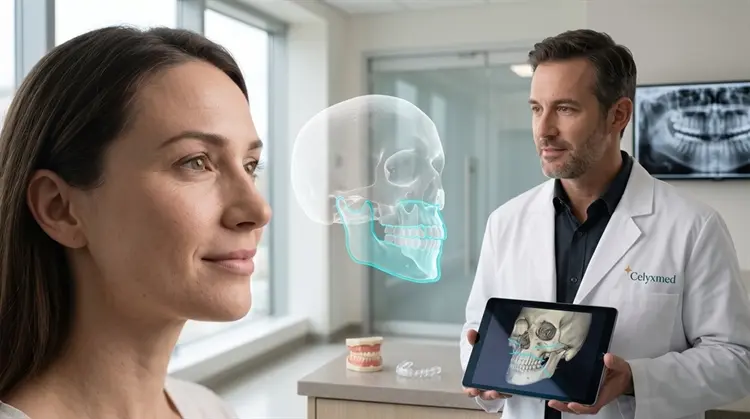
- 3D Digital Planning: Prior to the surgery, bone incision lines are calculated metrically thanks to three-dimensional tomographies (CBCT) and computer-aided surgical simulations.
- International accreditation infrastructure: Procedures are performed in fully-equipped hospitals possessing international quality and safety standards such as JCI (Joint Commission International).
You can contact us to get information about the specific planning and preliminary evaluation process for your case.
Most Commonly Used Orthognathic Surgery Methods
The bone structure to be intervened upon varies according to the needs of the case. Since all operations are performed intraorally (under the mucosa), there are no visible incision scars on the face from the outside.
1. Upper Jaw Surgery (Le Fort I Osteotomy)
It is the repositioning of the upper jaw (maxilla) forward, backward, upward, or downward by completely releasing it along with the teeth.
- Who it is suitable for: It is suitable for patients whose upper jaw is situated very far back, who have excessive gum display when smiling (gummy smile), or who have an anterior open bite.
- Limitations: Since it is directly related to the upper airway anatomy, slight (usually millimetric) changes in the nasal base and shape may occur after the procedure.
2. Lower Jaw Surgery (Bilateral Sagittal Split Osteotomy - BSSO)
It is the procedure of moving the anterior body carrying the teeth forward or backward by separating it from the back part of the lower jaw bone (mandible) in a planned manner.
- Who it is suitable for: It is the standard approach for individuals with prominent lower jaw recession or protrusion.
- Limitations: Because the work is done very close to the nerve line passing through the jawbone (inferior alveolar nerve), there is a risk of experiencing temporary numbness in the lower lip and chin tip after the surgery.
3. Double Jaw Surgery (Bimaxillary Osteotomy)
It is the intervention on both the upper and lower jaw within the same session.
- Who it is suitable for: It is suitable for advanced incongruity cases with complex facial asymmetry where moving a single jaw is not enough to achieve the correct bite.
- Limitations: It requires a longer operation time and a more intense postoperative edema process compared to single jaw surgery.
4. Chin Surgery (Genioplasty)
It is the forward or backward movement of only the chin tip bone by cutting it, without touching the dental bite. It is usually combined with BSSO to maximize aesthetic profile harmony.
Golden Rules in Clinic Selection
Orthognathic surgery is an area completely separate from general dentistry, requiring advanced surgical and anesthesia expertise.
- Hospital environment requirement: These surgeries cannot be performed in clinics. Inquire whether the institution of choice is a fully-equipped hospital with a general anesthesia unit and intensive care infrastructure.
- Orthodontic and surgical harmony: For a successful outcome, the surgeon and orthodontist must conduct the pre- and post-operative planning together.
- Digital simulation (VSP): Find out if the clinic can show you the surgical outcome and bone movements before the surgery through 3D Virtual Surgical Planning (VSP).
- Experience and expertise: Verify the specialization background in Oral and Maxillofacial Surgery and the experience in similar asymmetry cases of the doctor who will perform the procedure.
- Realistic timeline: Choose institutions that provide you with honest information that the surgery is just one stage, and recovery and subsequent orthodontic stabilization can take months.
What to Expect: Recovery and Care Timeline
Orthognathic surgery requires a long-term commitment. The recovery process occurs in stages:
- Preparation Phase (6-18 Months): Pre-surgical orthodontic treatment begins. The teeth are intentionally "misaligned" or aligned so that they will bite perfectly when the bones are moved to their new positions after surgery.
- Surgery and the First 1-3 Days: The operation takes place under general anesthesia. Patients are usually hospitalized for 1 to 3 days for observation. Prominent edema (swelling) begins in the facial area.
- First 2 Weeks: This is the most challenging period. The jaws may be fixed together with special elastics for healing purposes. A completely liquid diet (soups, juices, protein shakes) is applied during this time. Swelling reaches its peak and then begins to subside rapidly.
- 1st to 2nd Month: Bone fusion accelerates. With the doctor's approval, a transition is made from a liquid diet to a soft diet (purees, pasta, etc.). Patients can usually return to their work and social lives at the end of the first month.
- Long Term (6-12 Months): Bone healing fully settles. Post-surgical orthodontic treatment continues for a few more months to perfect the bite, after which the braces/aligners are removed.
When to see a doctor? A physician should be consulted immediately in case of severe pain that constantly increases and does not respond to painkillers, foul-smelling discharge from the surgical site, severe difficulty breathing, or a high fever (a sign of infection).
Post-Treatment and the Celyxmed Approach
As Celyxmed, located in Ataşehir, Istanbul, we approach the complex surgical needs of our international patients within a transparent and reliable framework. All of our aesthetic surgeries and skeletal jaw surgery operations are performed in partner hospitals holding JCI accreditation, where the highest safety protocols are implemented. With our expert team's over 15 years of experience and a track record of more than 10,000 successful treatments, your medical processes are planned with detailed radiological examinations. From pre-arrival online consultation to hotel-hospital transfers and follow-up procedures after returning home, all your steps are coordinated by our professional medical team.
You can contact us to find out your suitability for orthognathic surgery and to get a medical preliminary evaluation.
Skeletal jaw problems are not a destiny you have to endure for a lifetime; with a correctly planned medical intervention, you can fully regain your chewing, speaking, and breathing functions. Is it functional difficulties or aesthetic concerns that primarily drive you to research this process?
*This content has been prepared for general informational purposes only and does not replace professional medical advice, diagnosis, or treatment; results may vary depending on individual circumstances.