 Deutsch
 English
 Türkçe
Graft Survival Analysis in FUE and DHI Hair Transplant Methods
Many people experiencing hair loss have a legitimate concern when deciding on surgery: will the transplanted hair follicles (grafts) take hold in their new location? Today, modern microsurgical techniques such as FUE hair transplant and DHI, when performed with the right clinical protocols, largely eliminate this concern. However, patients often look for a clear, scientific answer to the question, "Which method gives hair follicles a higher survival rate?" Graft survival, as it is known medically, depends directly on the time hair follicles spend outside the body, the physical trauma they are exposed to, and the moisture level of their storage conditions. Here is a comprehensive guide to graft survival, process differences and your expectations when comparing FUE and DHI hair transplant methods:
Key Takeaways
- Graft survival depends on the "cold ischemia time" and the mechanical protection conditions during the process that begins when follicles are harvested from the donor area and ends when they are placed in the recipient area.
- FUE hair transplant is a proven, efficient protocol that is frequently preferred for high graft counts to cover large areas of baldness in a single session.
- DHI hair transplant offers the advantage of direct implantation (with the Choi pen) by minimizing the time follicles spend outside the body, and in theory reduces follicle stress.
- In both methods, final success depends less on the name of the technique used and more on the experience of the medical team and the quality of the storage solutions.
What Are FUE and DHI Hair Transplants and What Do They Include?
FUE (Follicular Unit Extraction) and DHI (Direct Hair Implantation) are procedures in which healthy hair follicles are harvested one by one from the donor area (usually the back of the head) with the help of micro motors and transplanted to bald or thinning areas. These methods are based on modern microsurgical principles that involve no strip incision, require no stitches, and aim to keep graft survival as high as possible.
The main situations in which these methods are used are as follows:
- Male pattern hair loss (Androgenetic alopecia).
- A receding hairline and baldness at the crown due to genetic or environmental factors.
- Localized, permanent hair loss caused by wounds, burns or trauma scars.
- Density-enhancing and repair procedures in the beard, mustache or eyebrow areas.
Who is not a suitable candidate? People who do not have enough healthy hair follicles of sufficient density in the donor area for transplantation, who have total baldness (alopecia totalis), or who have an active, severe scalp disease (for example, uncontrolled lichen planus) are typically not suitable candidates for these procedures.
Why Are Turkey and Istanbul So Popular for Hair Transplants?
- High Case Volume and Expertise: Turkish medical teams, who have seen thousands of cases a year for more than a decade, form highly skilled teams with the most intensive hands-on experience in the world in hair transplant technologies (especially sapphire FUE and DHI).
- Modern Technology and Graft Protection: Leading clinics offer up-to-date medical infrastructure as standard, such as special cooling solutions containing ATP (Adenosine Triphosphate) that improve graft survival, sapphire-tipped blades and modern Choi pens.
- Integrated Health Tourism Infrastructure: Offering accommodation, airport transfers, native-language patient counseling and post-procedure follow-up for international patients in a single plan turns the process from a medical operation into a comfortable travel experience.
To determine the most suitable method for your hair structure and to start planning, you can contact us for an online preliminary evaluation.
FUE and DHI: How Do the Methods Work and How Do They Affect Graft Survival?
There are three main factors that threaten graft survival: dehydration (drying out), mechanical trauma (crushing of follicles with tweezers) and cold ischemia time (time spent without oxygen). Below you can find how these two popular methods work and how they protect survival rates.
1. FUE (Follicular Unit Extraction) and Graft Survival
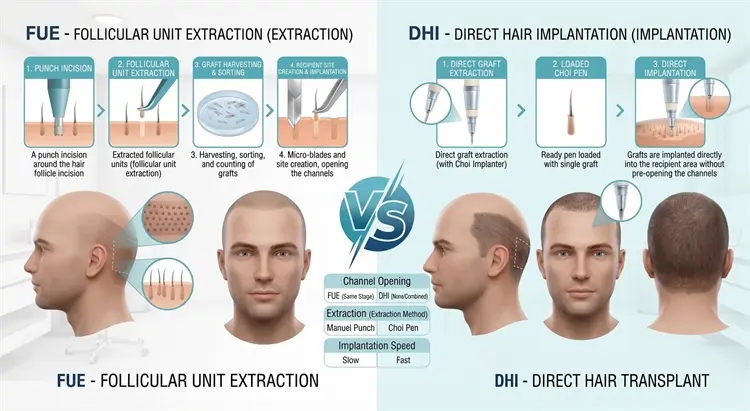
In the FUE method, hair follicles are loosened with a micro motor and collected, and while channels are opened in the recipient area, the collected grafts are kept in special nourishing solutions. The follicles are then placed one by one into these opened channels.
Because this procedure generally allows a large number of grafts (4000 and above) to be transplanted in a single session, it suits patients seeking high efficiency over large areas. Its most notable limitation is that the time grafts spend outside the body is generally somewhat longer compared with DHI. However, keeping the follicles at a suitable temperature (+4°C) in medical coolers and in hypothermosol (or similar organ transplant) solutions slows cell metabolism during this waiting period and keeps the survival rate above 90-95%.
2. DHI (Direct Hair Implantation / Choi Pen) and Graft Survival
In the DHI method, the grafts collected from the donor area are loaded into special implanter pens called "Choi Pens." The moment the clinician pierces the skin with the needle at the tip of the pen, the follicle inside is released directly into the tissue; in other words, channel opening and implantation are carried out at the same time, in a single motion.
It is extremely suitable for patients who want a no-shave hair transplant or who want to add density in a narrow area between existing hair. Because the time follicles spend outside the body is minimized and less mechanical pressure is applied to the follicles with tweezers, graft survival is theoretically preserved perfectly. Its limitations are that the procedure requires very intensive teamwork, progresses more slowly than FUE, and the maximum number of grafts that can be safely transplanted in a single session is typically more limited (usually around 2500-3000).
FUE and DHI Hair Transplant Prices in Turkey and Cost Comparison
In hair transplantation, pricing is not set like the sale of a standard product; it is determined by the surgical effort applied, the technique, and the hygienic/technological infrastructure the clinic offers. The DHI method is generally more costly than the FUE method because of the cost of the single-use Choi pens and the large team of specialists the procedure requires (technicians who load follicles into the pens).
| Treatment Method | Turkey (Estimated Range) | United Kingdom (UK) | United States |
|---|---|---|---|
| Standard / Sapphire FUE (Large Area) | $1,800 - $3,000 | $5,000 - $9,000 | $7,000 - $12,000 |
| DHI (Densification / No-Shave) | $2,200 - $3,500 | $6,000 - $11,000 | $9,000 - $15,000 |
*Prices reflect general market averages; exact costs become clear after your personal consultation and once the number of grafts needed has been determined.
Golden Rules for Choosing the Right Clinic
Hair transplantation is an irreversible aesthetic procedure. To protect your donor capacity and avoid putting graft survival at risk, you should pay attention to the following rules when choosing a clinic:
- Accreditation and Reliability: Get in touch not merely with an intermediary tourism agency, but directly with institutions that hold authorization certificates approved by the Turkish Ministry of Health (such as USHAŞ) and that provide services to global quality standards.
- Experienced and Stable Medical Team: Extracting and implanting grafts requires millimetric precision of the hand. Make sure the procedure is performed by an experienced team that has worked together for years.
- Realistic and Unfiltered Cases: Make sure the before/after patient photos the clinic shows you are real results, taken from different angles, unfiltered and free of lighting tricks.
- Materials and Solutions Used: Ask whether the storage solutions that are vital for graft survival are used (for example, special organ preservation solutions instead of isotonic saline).
- Realistic Planning and Promises: Stay away from commercial approaches that claim to transplant 6000-7000 grafts in a single session and guarantee 100% success; these numbers create a risk of permanent damage (necrosis) in the donor area.
Questions to Ask Your Clinic Before Booking
- Based on the number of grafts I need, is FUE or DHI more suitable for me? Why?
- Is the capacity of my donor (back of the head) area sufficient for this procedure, and might a second session be needed in the future?
- How many millimeters (mm) will the tip of the micro motor be during extraction (follicle harvesting)?
- In which special solution and at what temperature will my grafts be kept while outside the body?
- What protocols are applied to minimize the risk of infection during and after the operation?
- Does the treatment package include accommodation, airport transfers and the first wash?
- How will you stay in touch with me during my recovery after I return to my country?
Your Expectations: Recovery and Care Timeline
| Period | What Might You Experience? | What Should You Pay Attention To? |
|---|---|---|
| Days 1-3 | Tightness in the back of the head (donor area), mild swelling (edema) in the forehead area and redness in the recipient area. | To reduce swelling, sleep on your back with your head raised at a 45-degree angle, and make sure the recipient area never rubs against anything. |
| Days 4-10 | Scabs formed by clotted blood and fluids become noticeable in the recipient area, and a mild itching sensation begins. | Wash lotions and special shampoos given by your doctor should be applied gently (without rubbing), and scabs should not be forcibly removed. |
| Weeks 2-4 | Shock loss phase; most of the transplanted hair shafts begin to fall out (with the follicles remaining inside). | This is a completely temporary and natural cycle. Pay attention to nutrition without worrying, and stay away from stress. |
| Months 3-6 | New and permanent hair shafts, having completed the resting phase, begin to emerge at the skin surface in a fine form. | The scalp should be protected from the sun's direct and harmful rays, and chemical gel/spray should not be used without your doctor's approval. |
| Months 12-18 | Hair shafts reach their final thickness and full form. This is the period when results are clearly assessed. | The hair can be shaved, combed and styled just like your natural hair. |
When Should You Contact Your Doctor?
Mild oozing, redness and scabbing in the first few days after the operation are a completely normal part of the healing process. However, if you experience the following signs, which show that your body is reacting unusually, you should contact your doctor or clinic without delay:
- A sudden rise in body temperature that does not fall below 38 degrees despite fever reducers.
- Throbbing pain in the recipient area or the back of the head that is not relieved by painkillers and keeps getting worse.
- Foul-smelling, yellow or green pus-like discharge on the scalp (suspected infection).
- Fresh, active bleeding that starts suddenly after the first day and does not stop.
- Swelling (edema) that quickly moves down from the forehead toward the eyelids and grows to a degree that makes it hard to open your eyes or see.
The Post-Procedure Period and the Celyxmed Approach
At Celyxmed, we serve at our center in Ataşehir, Istanbul, to international standards backed by our ISO 9001, ISO 13485 and USHAŞ certificates. With our well-established hair transplant team of more than 15 years of experience, we have performed more than 10,000 successful treatments to date. For our patients' comfort, we carry out a detailed photo evaluation before arrival in Turkey and carefully organize the treatment, accommodation and transfer processes. In addition, to support graft survival and repair the scalp tissue, we also offer innovative applications such as exosome therapy as part of modern hair loss treatments.
To determine the most effective method for your hair loss problem, you can contact us for an online preliminary evaluation.
When planning your hair transplant journey, what concerns you most: the time you will spend on the day of the operation, or your recovery speed and graft survival?
*This article has been prepared for general informational purposes only, does not replace medical advice, and individual treatment results may vary from person to person.